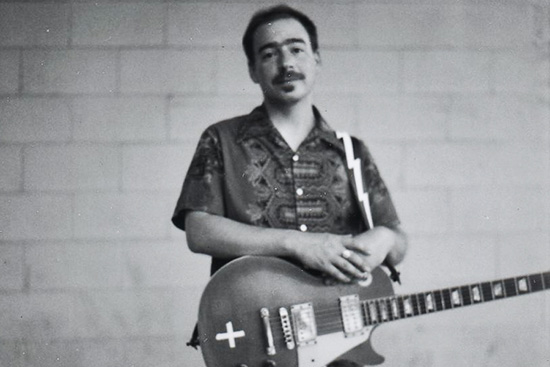
I walked into the Doug Fir Lounge in Portland, Oregon. In four hours Magnolia Electric Co. would be playing songs from its new album Josephine to a sold-out crowd. Told by Jason Groth, guitarist for M.E.C., to look out for a recently grown mustache, I found frontman Jason Molina eating dinner at the bar. I waited for him to finish his meal. It was interesting to wonder, as those few minutes passed, if he was writing any songs in his head while he ate, or perhaps envisioning a future painting. Unsurprising from such a prolific songwriter, over the next hour I would begin to understand just what a creative spirit Molina has. We walked down the street for some pinball, a beer, and a quiet spot to conduct an interview.
melophobe: I read a previous interview where you mention that you have moved around a lot over the years. Do you find a nomadic lifestyle necessary for creative reasons? Or is something else pushing you from place to place?
Jason Molina: I'd just go with circumstance. I have a chance to move, I take it. It's not necessary for any part of the songwriting process.
melophobe:You're now in London. How is it? Was there any serious adjusting?
JM: It's a been a really hard couple years finding musicians that are of the caliber that I'm used to. I feel uncomfortable meeting a great bass player in London and saying, "I'm Jason Molina. Do you want to come and work on some songs?" That's not a good musical start. In the U.S., I'm just like, "You're a great bass player. Do you want to come over for four hours on Wednesday and work on some songs?" And people always say yes. Overseas that's not really the case. It's been difficult. I find myself writing a lot with just the acoustic guitar and a pile of lyrics.
melophobe: As well as music, you create a variety of visual artwork. One thing that caught my attention, you give names and contexts to found objects. Can you tell me a little about that?
JM: A song to me sometimes takes on the structure of being a box full of things collected along the way. You shake up that box and you open it up and it's the same things collected, but it's the associations that matter. You know, this rock and this little button and this little folded up piece of paper and this little love letter. That's the way that songs really help to ground you, I think, if you also think about the songs as a visual element. I'm not talking about like a short film—that's very literal—but just a bunch of objects. You know, a handful of rocks and things that I've found on the road, there's a song in there but I've chosen not to sing about it. That little black obsidian arrowhead that I found, could be, at the moment, a song.
melophobe: Josephine was released just a few days ago. How was this album born and how did it evolve over the time spent developing it?
JM: Our bassist, Evan, had a lot of input into some of these songs and also the tonality of this record. Evan died before we were able to get into the studio. The studio time was already booked and I was ready to just put everything down and not be in that head space anymore. Of course, I would always be playing music and be writing songs, but it just never occurred to me that there had to be another record. I think I had just enough time to deal with Evan's death in my own way, separate from the band because they were in southern Indiana while I was working on the music for the record. I think I had just enough time to wake up and say, "I have to do this record." To me it couldn't be a really strict ending. It had to incorporate all of the ideas that Evan and I had talked about for weeks and weeks and weeks about songs and the approach to recording and allowing freedom for the individual musicians. That's something that I had not really taken into account all of the way. You know, I've got these musicians. They all play a lot of instruments. They really have a shitload of input that they could offer. So, one of the ideas that Evan had, and I agreed wholeheartedly, was just open the door, just come in and say, "Well, here's the song, here's the chord progression. What do you think would sound best? Maybe Michael doesn't want to play keyboards on it, although typically he would. Maybe he wants to do the horn part or a neat backing vocal." To open it up in that way, that was the germ for making this record.
melophobe: You talk often of the importance of song cycle. I have never seen you perform live, but will tonight—does the song cycle of an album lose precedence during a live show, or do you preserve it?
JM: No, I think that the document of the song cycle is in the record. Extracting a song out of that and juxtaposing it with a song from another cycle is not problematic at all. I don't think that it devalues either project, whether the live performance or the original record.
melophobe: Your songs have an intimate sound. Is it tough to portray that same feeling night after night?
JM: Well, it doesn't come easy. I'm not trying to perform the songs. I'm up there on stage not even thinking as a platform. I'm just playing a song. Often I'm thinking of something completely separate from the lyrics. Although I'm completely invested in what the lyrics are and what the song is, I'll look out and there will be a crowd full of people and I don't see a single one of them. I think about making pottery, cabinets—I'm thinking of something else. And the song ends, and then like a lightning bolt another song comes.
melophobe: Are you usually thinking along artistic lines?
JM: Absolutely. Or building something, or constructing something. That's how I approach songwriting anyway. You're building something, you're just building it out of paper.
melophobe: You're from the Midwest. What are your opinions of the Pacific Northwest?
JM: I've been playing out here for a long time. I was a huge Mudhoney fan. I remember the first time that they rolled through the Midwest. It was just me and nobody else going to see them. Nobody had heard of these bands. Also I'd see some bands in Chicago, or by the time they got out to Cleveland. Anywhere I could get to. I used to take the Greyhound just to go to concerts when I lived in West Virginia because no bands would come down that far south. I would just travel around knowing really nothing other than a friend had made a mix tape with two songs from this great Northwest band on it. Next thing I know, I have to find this band. Shitloads of good music came out of this area. A shitload of good music is still here. It's a whole part of the world that I haven't really put my foot on, other than going to rock clubs and driving. There's a lot I can learn out here.
melophobe: Do you find that touring in North America differs greatly from touring in Europe? Is your music received differently between the two?
JM: Typically in Europe they lean heavily towards the category of Americana. I've never once thought of myself like that. It's just songs to me. Hell yes, I wear a flannel shirt a lot of the time, but living in Ohio, living in the mountains of West Virginia, a flannel shirt is part of your gear. Over in Europe, you'll see an opening band that is inevitably dressed almost like a classic CCR photo or something. They dress up like what they think an American band ought to look like. I've never cared about that stuff because when I first discovered really interesting bands—punk bands, psychedelic bands, heavy bands—I wasn't seeing this in magazines or television. I was learning about this just from the songs. I never even cared what they looked like. I just thought, "Damn, that's a great song. I've got to try to write one at least that good or better." The way that musicians are perceived in Europe, if you dress up a certain way, that's the audience you're going to attract. I think it's better, at least in Europe, to not calculate how your perceived. Let them put the pieces together.
melophobe: You have said that, "Music is my blood, I don't know how to live without it." I understand that being a musician is not simply a chosen career path, but a passion that would come out regardless. That said, if you weren't a musician or an artist, is there any "day-to-day" job that you would be happy with?
JM: A dishwasher. I'm good at it. Something like that. Something that has mechanics, a system, and possibly the open ended angle where I can adjust the system. You know, on Friday, Saturday, and Sunday we're going to be really slammed so maybe I can adjust the system to do the good job that I have to do, but it might mean that I come in an hour early to reconfigure things. I like that.