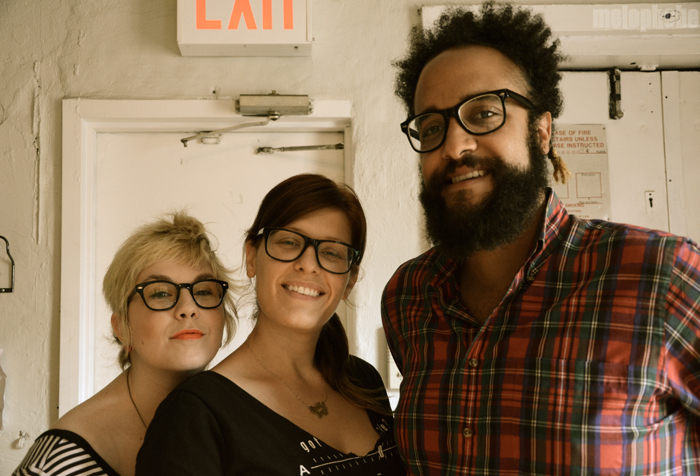
On July 7th, Melophobe will be seeing Pearl and the Beard play their biggest show ever, at the Music Hall of Williamsburg with Franz Nicolay and Brian Bonz. To get psyched up for what promises to be a great show, we spoke with two of the band's three members about what its like to be a young musician in the age of the Internet, how the band formed, and how many teeth the band's members actually have.
Melophobe: So let's start at the beginning. I think the first time I heard about you guys was when you did that Will Smith medley video.
Jeremy: I’ve never heard of that.
Emily: Yeah, I have no idea what you’re talking about.
Melophobe: So I think that’s a good place to start. You guys kind of got on the scene with that video, a sort of viral thing. Is that when you started getting attention?
Jeremy: It was kind of like our – I’ve heard the term Trojan Horse. That introduced us to a lot of people initially and really helped. But then I think once people stopped showing each others’ co-workers, which happened very shortly after that – that was kind of our first push and then after that it was mostly touring. And people now, eventually, just sharing the music. But that was a nice sort of introduction.
Melophobe: Do you feel like you have to fight against that in some way? To show people that you’re more than just a cutesy cover band?
Emily: I felt that way a little bit, actually. In general, when people try to describe what we do, they tend use really perky words –
Melophobe: Yeah, I noticed that. I actually have a list written down of words like “whimsical” and “jubilant” and “scrumptious,” and I was going to ask you how you feel about that.
Emily: Yeah, exactly. I feel like I’m the most sensitive to that, for some reason. I mean, the reality is that everyone is made up of a bunch of different emotions. It’s not likely everyone functions perkily all the time. Not everyone is angry and moody and brooding all the time. And to allow an entity to be that way as well, I think might be foreign to people. They talk to you like, “Oh, this band is really moody.” or “They’re shoegazing.”
We kind of get tagged, for one reason or another, as “Jubilant!” and “Sugary!” I’m more sensitive to that because I feel that we’re really not. Our songs are full of really forceful symbolism, to us.
Melophobe: And I think a lot of that is people latching onto ideas like – Oh, they have boys and girls and they have harmonies! And not looking past the superficial to see that it’s actually soulful stuff and there’s a lot behind it.
Emily: Exactly. A lot of these songs have really personal meaning to each and every one of us. They all come from a really personal experience that we’ve had that maybe isn’t so happy. And a lot of them aren’t. A lot of them are connected to very serious things that have happened to us.
And of course, because we’re also all kind of goofy people, we enjoy being goofy. That one video just happened to capture that. We were in rehearsal and I was bored. We were rehearsing and I just started playing a riff and Jocelyn -- who is hilarious -- just started messing with Will Smith on it. And it was attractive to people because it was easy and fun.
That’s a lot of what it’s like to meet someone. They pull you in with your humor or kindness, and once you get past that you see the deeper side of people, which is actually a lot more interesting.
Jeremy: I totally agree with that. I, for one, am glad that we didn’t totally break our backs trying to come up with that song. We didn’t break our backs trying to film it. I think everyone did a great job doing it, but everything was so effortless that we didn’t think about it and it just kind of got out there. But yeah, I agree, that’s part of our charm – that we’re very warm people when you get to know us. I use humor as sort of a offense, or whatever you want to call it. But what Emily said is great, it’s a great way of introducing us to people like “Hey, we’re approachable – now get ready to get fucked by your own tears.”
Melophobe: Haha. The band that I kind of draw parallels to, with all that – even though your music is very different – is Freelance Whales, who I think have built kind of a similar vibe; they have guys and girls, they play glockenspiels, they perform on subway platforms in New York. I talked to them about a year ago, and what they said was kind of “We just go out there and do our thing on subway platforms, but busking isn’t who we are. It’s a way for us to get people who are just walking by to stop and stay and get involved.” It’s that Trojan Horse that you’re talking about.
Jeremy: I do like Freelance Whales; I have their album. And I’d like to credit Das Racist with that Trojan Horse metaphor.
Emily: Das Racist? Oh my gosh, that’s right.
Melophobe: Wait, so did they say that about you, or did they say that about “Combination Pizza Hut and Taco Bell”?
Jeremy: Yeah, they said that about the Taco Bell/Pizza Hut thing. It’s funny, because there’s that magazine Deli Magazine in New York, and they have that thing every month where it’s like “Band of the Month.” And it’s so funny because we tied with them a year and a half ago. Which is really funny. And they come up every once in a while. I had some sort of event with them and they played it. And I see them on the streets all the time. And it’s like, “Das Racist!”
But they said that song was their Trojan Horse and I liked that.
Melophobe: Yeah, it’s a great example of that. I wanted to ask you about being a musician in the modern age, where in some ways it’s so much more than making good music. But then, on the other hand, sometimes it’s nothing more than making good music. Where artists feel like they have to do all of this stuff to get noticed, but in the end, hopefully, if you’re making good stuff it’s going to be found.
Jeremy: Right. Have you ever read that book The Tipping Point?
Emily: Uh oh, Jeremy. Literature.
Jeremy: I’m about 80 pages deep into it. But it’s basically, yeah – your thing needs to be in front of the right people, but when it comes down to it, you have to have substance, you have to have something that will actually go past the hype.
Because yeah, we love the new flash in the pan thing. I love sending things to my co-workers. I love being like “I discovered this thing.” But that can only go so far because we have short attention spans – mine included – and if you don’t have something else there…
Emily: Yeah. In addition to that, our manager Wes Verhoeve of Family Records, is constantly on us saying, “Guys, you have to slow down. It’s a slow burn. You can’t expect things to rush.” Because we could do that – we could bring in something that’s super hooky or super campy, or whatever it is that creates that instant buzz. But it’s whatever creates the things that last the longest, or things that are around longer, that you build one strand at a time. It’s like building a relationship of trust. Maintain these relationships for a very long period of time. It’s like that in the changing music industry. It would be interesting to look back and talk to someone twenty years ago.
Jeremy: I like that now music is so accessible to everyone. Everyone can make music and videos in their own bedroom. I think there’s a saturation of music and a saturation of blogs and all that stuff, but I think it brings it all back to that equilibrium. Because now there’s nobody that has a monopoly on what’s good. Which I like. You don’t have a radio that’s pumping songs down your throat because now we create our own stations of what you like. Usually you don’t have to be bombarded with stuff you don’t want to hear.
We’ve been listening to the radio a lot now, Pearl and the Beard is, because our CD player is broken.
Emily: And as a musician, what we’re talking about can work for you or can work totally against you. Because there’s so much material. Jeremy talks about it a lot. On iTunes you can go and you can preview a 15 second section of someone’s song and if you don’t like it immediately you move on. Whereas before, in the olden days of the 80s and 90s, you bought albums because you heard and liked one of ten songs. And then you were forced to listen to the whole thing because you bought it. Like, “No, I bought this whole thing and will listen to it. Now I own it.” The whole album kind of grew on you. And then became the album that defined your life at that period of time.
Melophobe: Well it’s like a self-fulfilling prophesy, where it’s more than “I’m going to give this a chance,” it’s, “I spent $15 on this, I’m damn well going to like it.”
Emily: Exactly! And that doesn’t exist anymore. This saturation is great in the sense that everyone has a voice. But it’s so bad because your voice may not be heard, it may be lost amid all of those soundwaves.
Melophobe: It’s interesting, too, that we’re not all listening to the same things anymore. In some ways, it’s really easy to self-segregate and only listen to one sort of thing and not let those outside influences creep in. Do you find yourself getting tunnelvision? Is it good to sometimes keep those outside influences from affecting you and your music?
Emily: It’s a fascinating question. I struggle with this on a very personal level when I’m doing solo stuff, or whatever. You want to be influenced by friends or by colleagues or by people you don’t even know, but at the same point you want that to affect you in a way that encourages you to keep creating. Everyone does it in different ways and has unique ways of thinking about these things. I struggle with that fine line between being super motivated and influenced and being super discouraged. And it’s really fine. Jealousy can creep in, because there are so many people doing what you want to do.
I fight that all the time. That’s the other thing – another part of your question – do you want to be influenced by so much by a peer or a friend or another musician, so much so that you’re not creating original music anymore? You’re just creating something that sounds like them.
That is a really difficult hurdle. I actually don’t even know for sure if we’ve gotten past there! It helps us, as a threesome, to come with our own individual influences, and that all gets weeded out. And I think that’s why we’re able to create something that we’re proud of. That we feel like we’re not actually copying someone or being over-influenced by other people that we absolutely love. We still want our own identity.
That is something that really helps – to have three like minds, even though we listen to completely different music as a trio.
Melophobe: So you guys met right when you formed the band? You didn’t know each other beforehand?
Emily: No. Jeremy and Jocelyn met in September of 2007 and then they met me in January of 2008. All separate. They found me together at an open mic, and they met each other at an open mic.
Jeremy: Actually, I was trying to assemble the most awesome team of musicians ever and I had been studying them for years.
Emily: It was Jeremy who talked to me on the very first night. I was sitting in the corner after I played, and they came up to me and Jeremy said, “My name is Jeremy. I want you to be in my band. I don’t know how you’re going to be in my band. I don’t know what we’re going to do with you. But you’re going to be in our band.”
Jeremy: I think I said, “We would like to work with you.” I think the reason we got Emily is because she was so fresh off the boat and nobody had ever asked her and she was like, “It’s true! I’m an exciting cello player!”
Melophobe: Where were you coming from?
Emily: I moved to New York from Utah. I had lived in Pittsburgh and moved back to Utah and then I moved from Utah to New York to do some post-grad work.
Melophobe: And that was shortly before you met at that fateful open mic?
Emily: Yeah. I was in school and I was taking classes inin cello performance classes for my post grad. And I was in the middle of my year and I met them. And I was going to do two years and I figured, “Well, I’m kind of in the middle of this interesting thing, but I’m doing more by playing music.” So I stopped and I made the band a priority.
Melophobe: Where did you guys get the name Pearl and the Beard? I know you get this question all the time.
Emily: Well, Jeremy was standing on a crate looking over a fence at Jocelyn who was picking grapes and eating them and getting sick…no, I don’t know. Jeremy, go.
Jeremy: We usually try to think of ridiculous stories to come up with without telling the actual story.
Melophobe: Well give me one then.
Emily: Jeremy, we always start it. You have to do this one.
Jeremy: OK. So I’m 100% Native American and Jocelyn and Emily are one half Native American. Jocelyn is from Canada, but it’s still North America so it’s still Native American. We did this retreat up to this weird sort of commune thing, where we had to do the smallest amount of peyote ever ingested. Like just enough to tickle your nose. And we sat in this 108 degree tipi for like an hour. And we walked out of that tipi and we’d all had these crazy visions and all sorts of other crazy things happened. And then we went to this bar and there was a band there that was really awesome and really attractive. And what we did was we stole their souls and we stole their looks and we just assumed their moniker. And that moniker just happened to be Pearl and the Beard so we figured fuck it, let’s just go with it.
Melophobe: Let’s just go with it.
Emily: I have to say, Jocelyn and I are a little bit better.
Melophobe: Well he’s just starting. He’ll get it.
Jeremy: Oh thanks.
Melophobe: Jeremy, I noticed that you have a beard now. I saw some older pictures where you didn’t have a beard – was that part of the soul stealing?
Emily: Actually we drugged him and shaved it. We were like we have to know what he looks like without it – we thought there was probably a different man under there. And there wasn’t.
Jeremy: Yeah, that was the last dying bit of me being like “Uh, maybe I won’t have a beard.” But that made everything more confusing.
Melophobe: So you have a new album out, and I read somewhere that you worked with Franz Nicolay on that. How did that come about?
Emily: That’s a good question.
Jeremy: Well he played on our first album.
Emily: Yeah, he played on our first album, accordion. And it came about when he had been doing arrangements for us on some songs. He did some arrangements for me on the Black Vessel EP.
He’s super professional and we loved his sensibilities, so we asked him about it and he was like, “I would love to do it.”
Jeremy: We know him through Anna Vogelzang and Emilyn Brodsky who are wonderful musicians. They were all connected with Franz, and Emily was friends with Anna and Emilyn, and we said, “Oh we could use some accordion on this,” for our first album. And Emily knew Franz. So he played with us and we sort of became pals from that. Then he started working with Emily more and as time went on he was doing more solo stuff. He has great ideas and writes wonderful arrangements.
It was actually co-produced, and this is very important as well, by this guy named Dan Brennan, who is in a band called Uncle Monsterface. And they worked side by side, which was very nice. It was very interesting to see them. It was kind of like having two directors.
Emily: They each took over different parts. Franz took over more of the musical arrangements and stuff and then Dan did more of the instrumentation and the science of it. The mathematical part.
Jeremy: It was all very natural.
Melophobe: And you’re happy with how the album turned out, I’m sure.
Jeremy: I always like to call albums time stamps and say that’s where we were at that time. And so that’s where we were at that time. It’s like with any piece of art that you make – there are times when you’re like “That’s amazing and it’s going to change the world!” and there are times when you’re like “This is horrible shit.” The exact same thing that you’re looking at. You can’t really trust yourself.
So the way I can make myself sleep at night is to think that that’s where we were at that time, we used all of the resources that were wonderfully donated to us at that time that we had at our fingertips, and we did what we could. And I think we made an amazing thing that I thought was great and something that was different from the last two. Anything that we want to change we change it in the shows; I think that’s what makes our live shows special and that’s what makes the album unique.
Melophobe: Yeah, I’m really excited to see you guys play. I’ll be at the show at the Music Hall of Williamsburg on the 7th of July.
Emily: Oh, you’re going to that! Awesome.
Melophobe: I’ll let you guys go, but first I have one very important question. I was looking on your website and I saw that it mentioned that you have 96 teeth amongst you, and I was wondering if you actually counted your teeth. Did you count your own teeth, or did you count each others’ teeth? How did that work?
Emily: That’s a great question. I think it was Jocelyn, and I think she was taking an average. Because I’ve had my wisdom teeth taken out.
Jeremy: I’ve had four of my teeth pulled out. So I think we should actually re-word that.
Emily: Yeah, we need to re-count that.
Melophobe: This is me fact-checking that number.
Emily: Man, you are thorough.
Jeremy: Like Henry David. Henry David Thoreau.
Emily: I am so sorry.