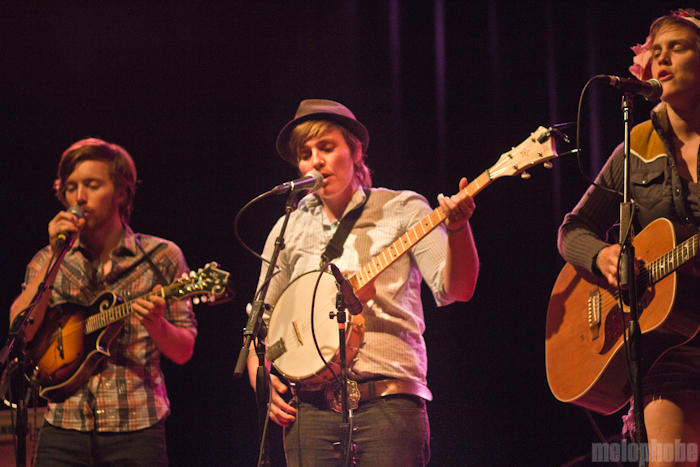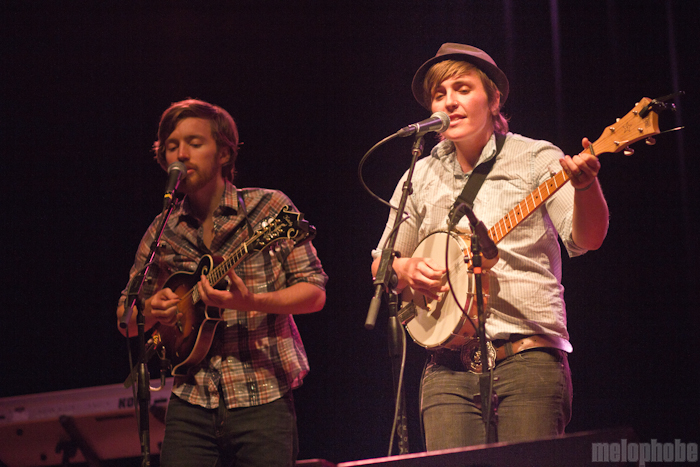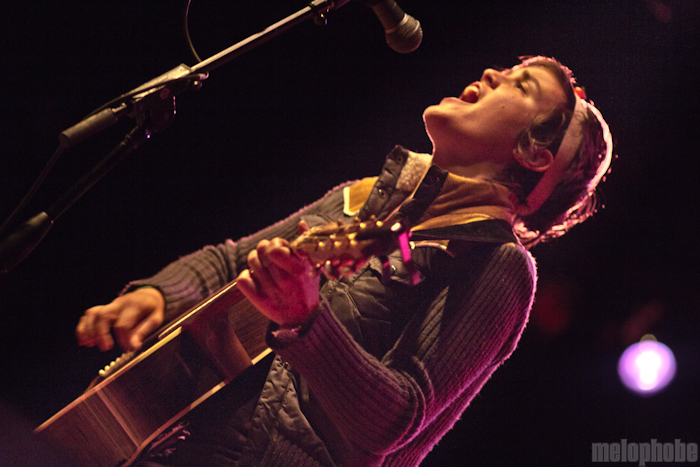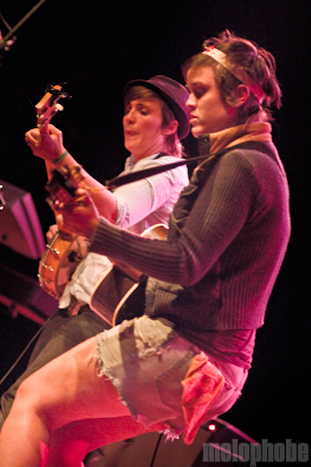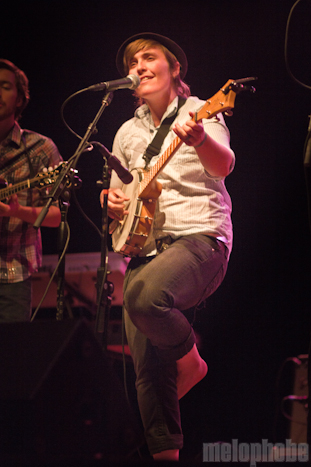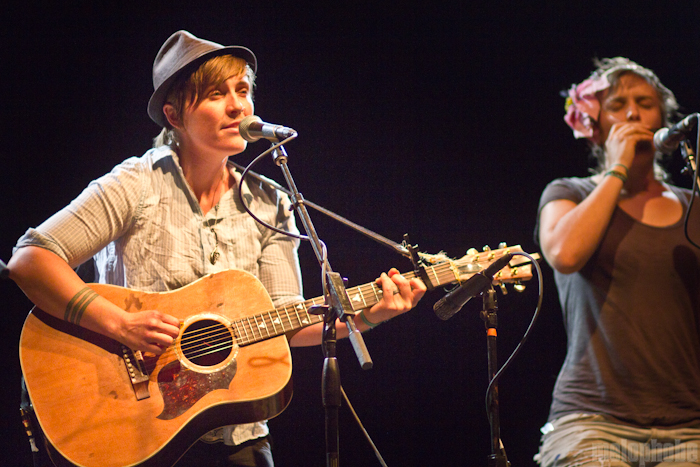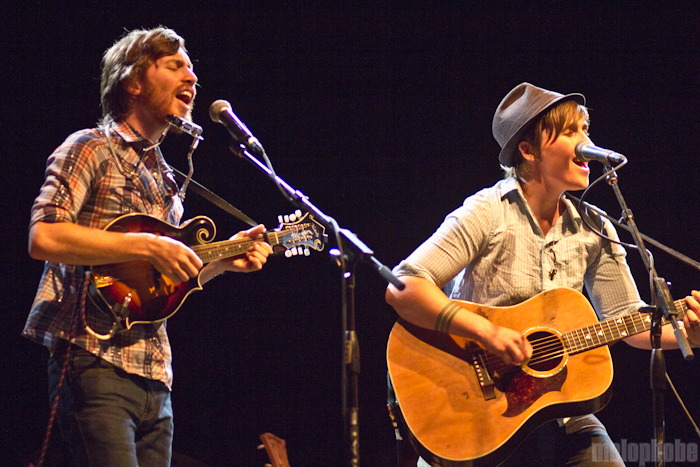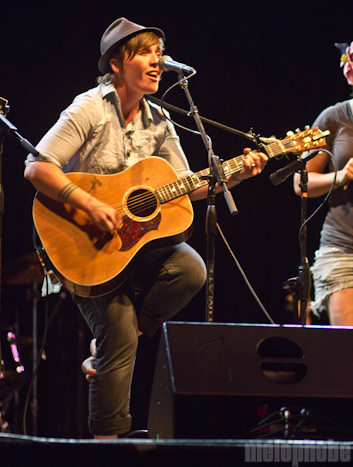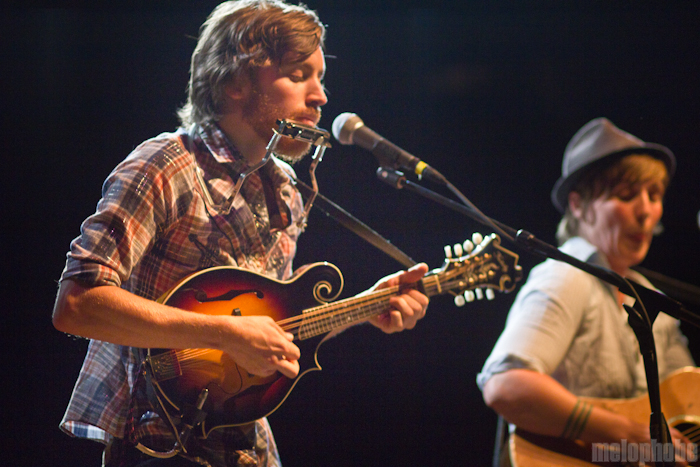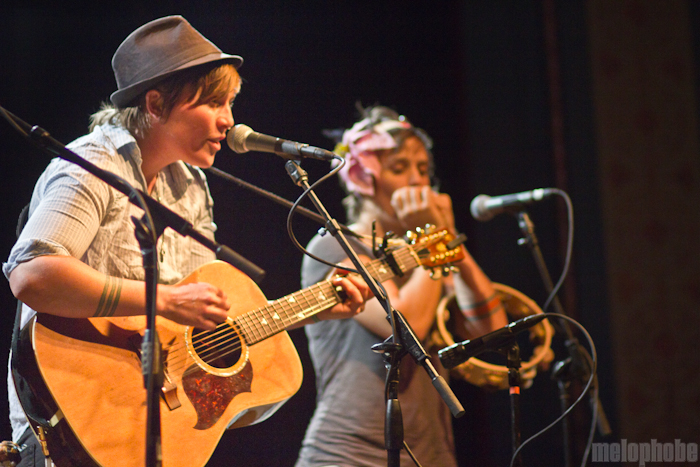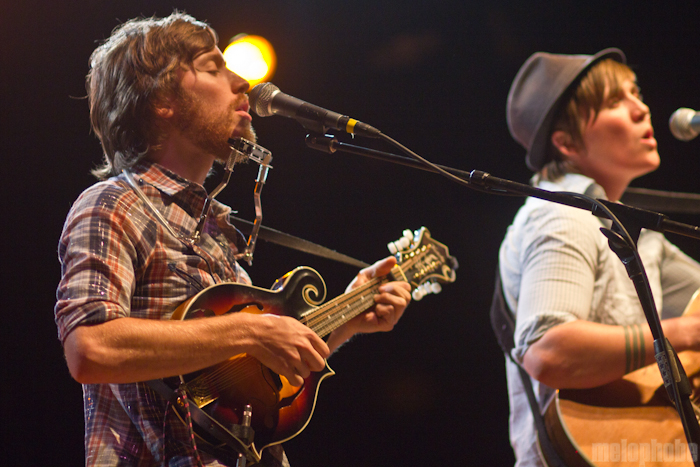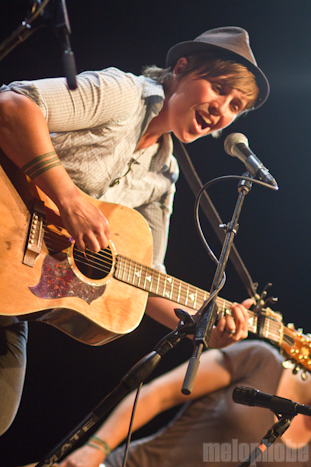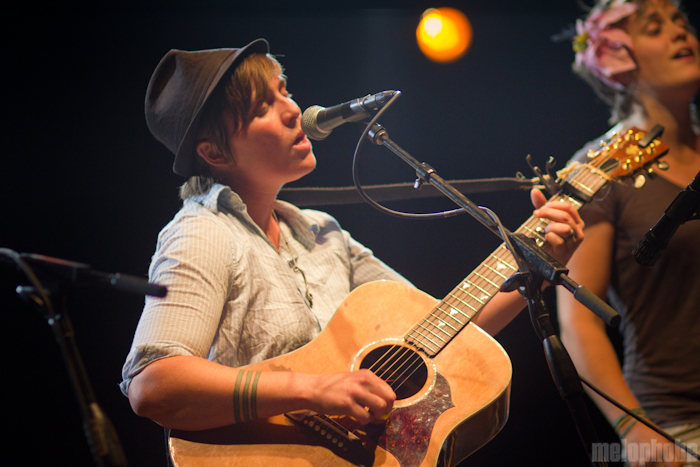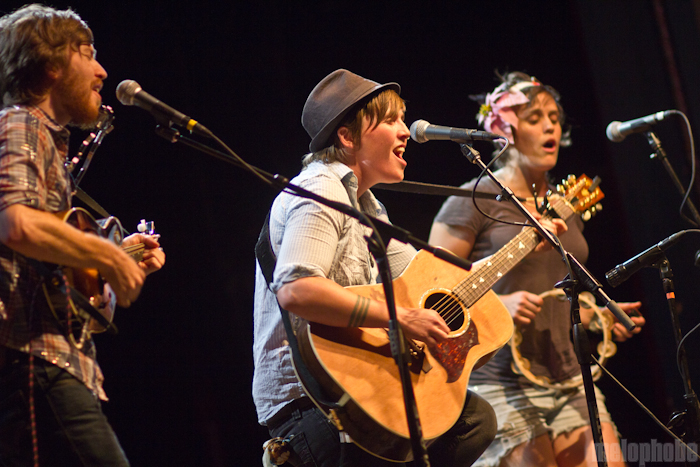
[Note: Photography of headliner The Mountain Goats was not allowed. Above are photos of opener Midtown Dickens.]
Any lingering doubts regarding the effectiveness of catharsis could never survive the overflow of emotion that characterizes a typical Mountain Goats set. Witness John Darnielle and company at the height of their powers, as they were when they performed “No Children,” the first song of the encore and highlight of Saturday night’s show at the Aladdin Theater. Witness the crowd joyously singing along to the heartrendingly pessimistic lyrics: “I hope you die; I hope we all die,” Darnielle shouts, modifying the line to include his audience in the tune’s hypothetical misery and self-loathing. Witness the hands raised in their hundreds, open palms to the lofty ceiling, as Darnielle cries, forcefully occupying the elusive intersection between lamentation and celebration, “I am drowning, there is no sign of land/you’re all coming down with me, hand in unlovable hand!” Witness the otherwise professionally standoffish security guard, body writhing, arms in the air, head swinging about ecstatically as Darnielle spins this story of a romance gone horribly awry. Witness, a few minutes earlier on the other side of the encore break, as a trio that comprises the opening act, Midtown Dickens, dances about on the stage as if they had never heard rock ‘n’ roll before tonight, seeking out any open microphone to lend their voices to the triumphant refrain of “This Year” as Darnielle prowls the front of the stage, reveling in whatever force it is that crafts profound union out of such monumental sadness.
Of course, moments like this don’t come out of nowhere. They are built up to, never an isolated moment but the culmination of a process. That process began with Midtown Dickens, and if their bluegrass inclinations don’t exactly mesh with rock ensemble that is the current iteration of the Mountain Goats, one can’t help but notice a like-minded belief in the power of music – a vague sentiment, undoubtedly, but one that was nevertheless evident throughout their set, as well as during their “This Year” cameo. With the theater-style seating filling up fast, Midtown Dickens opened their set in near-total darkness, immediately commanding of the audience the attention the music required. That rapt attention would persist through the entire set, always a credit to an opening act, and in spite of one member’s near complete loss of voice, the band achieved a certain connection with the audience that, rare though it may be, is what opening for a band like the Mountain Goats is all about. By their last song, the most uptempo number of their set, a couple dozen fans had moved to the front and were dancing in the open expanse between the stage and the first row of seats. The band was visibly delighted at the display, and it was only a pity that, having reached that climax, the set had come to its end.
The Mountain Goats set began, rather bafflingly at the time, with the incongruous sound of a death metal recording as the band entered the stage. The irony being obvious, even if the joke was not, the audience greeted the abrupt noise with an outburst of applause. In surprisingly seamless fashion, the metal faded as the band struck the first chords of “Liza Forever Minnelli,” a song considerably less abrasive than the music that had immediately preceded it. It’s a new track, which means, for the hard core of Darnielle’s intensely devoted fans, that it may have to spend a few more years aging in the barrel before it is properly canonical. Nevertheless, the song’s caustic reference to the Eagle’s “Hotel California,” which carries weight coming from Darnielle’s mouth precisely because he is the kind of songwriter that can call “bullshit” on a song like that, elicited delighted screams and howls from the crowd.
Though the show did not sell out in advance, the crowd certainly approached capacity as more and more fans filtered in throughout the first few songs of the set. The standing room area quickly filled up, and the overflow ran up the aisles well more than halfway to the back of the room, obstructing the view from what had previously appeared to be optimal seats, though if anyone minded, it was certainly not evident from the cheerful mood that prevailed among the audience. Darnielle proceeded through a winding tour of his discography, peppering newer material in amidst the standards and countless hidden gems that make the exploration of his archive so rewarding.
Indeed, Darnielle seems more at ease with that archive than ever. He laughed off a comment from a fan that “all of your songs are great,” but recent performances have seen him devoting ever more time to his less readily accessible pre-Tallahassee catalogue. That is certainly a welcome development to his longtime fans, who can be heard at any given show calling for some or another obscure song from a minimally circulated cassette-only release. But it belies the real appeal of John Darnielle’s music, which has always been his willingness to dwell on sadness, autobiographical or fictitious, and find the spark of beauty in such moments on which the human experience is founded. Darnielle’s performances in Portland are particularly rewarding on that measure, because his years spent here as a drug-addicted post-adolescent have been the direct inspiration for a surprising number of his songs, and indirectly were a contributing factor in the making of the insightful and introspective songwriter that he later became. On this night, we were treated to a story – “I must have told you this last time I was here,” Darnielle puzzled – about a past trip to Portland, where the anticipation of a surprise drop-in on a long-lost friend was spoiled by the revelation that the latter was, in fact, recently deceased. Stories like this – heartbreakingly, even conspicuously tragic, yet rooted in a fundamental, all-too-familiar sense of loss – in Darnielle’s able hands become the material for an exploration into the complex of discordant signals that is the human condition. It is these intimations, sometimes bleak or depressing, other times humorous, but always communicated as if between two friends facing each other over glasses of beer or something stronger, that stand out as the genuine and unique foundation of a Mountain Goats show.
Not, of course, to say that the music doesn’t matter. It does, absolutely, and when it is at its best, it takes on exactly that same figure of a profound truth communicated from one friend to another. It is quietly evident on some songs, such as the non-album “Tyler Lambert’s Grave,” and boisterously so on others, most notably the live standard “This Year,” with it’s anthemic resolve that “I am going to make it through this year if it kills me.” The Mountain Goats closed their set with the latter, and it was with a strange and overwhelming sense of solidarity that I reflected how much that song would have meant to me had it been written and available during my own teenage years, and how much easier things would have been to know then that, a decade or more on, all these people who had experienced these feelings could gather in a room and joyously sing about it without a hint of that old despondency.
After an encore of the aforementioned “No Children” and “Palmcoder Yajna,” a riotous track off 2004’s We Shall All Be Healed, the Mountain Goats closed out the night with “The Best Ever Death Metal Band in Denton,” thus completing the gag that had begun with the opening salvo of death metal growls and chainsaw guitars. On the surface, the song is a simple one, a narrative of two misunderstood friends whose dreams of death metal stardom are thwarted by the knee-jerk reactions of a disapproving society. Hardly autobiographical, then, but it comes around to Darnielle’s customary introspection in a single, poignant lyric: “When you punish a person for dreaming his dream/Don't expect him to thank or forgive you.” With that, the song summons the spirit of the narrative’s protagonists, coalescing into a metal-esque refrain of “Hail Satan!”, but unmistakably transforming it from a naïve and misdirected manifestation of adolescent revolt into a rallying cry for the pursuit of self-actualization. It’s a feat only Darnielle could pull off, and the multitude of hands raised with index and pinky fingers extended as the audience joined him in the chorus, testified to the easy universality of the themes he deals with. It was an exercise in collective catharsis, engineered by an artist who has mastered the practice, and for all the sadness his music evokes, in the end it yielded nothing but smiling faces as the crowd filtered out into a cool summer night on Milwaukie Avenue.