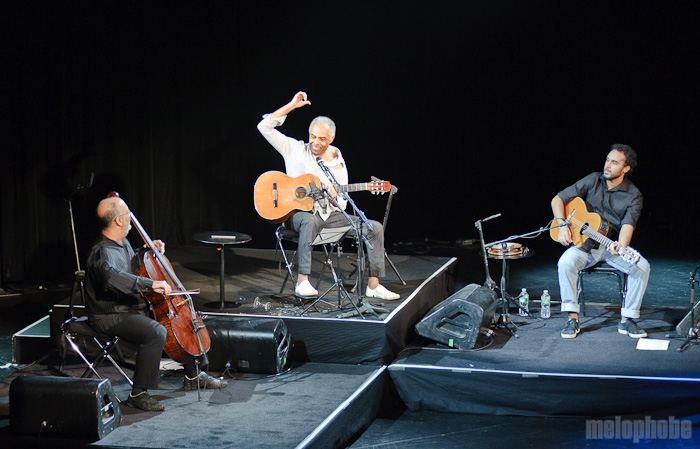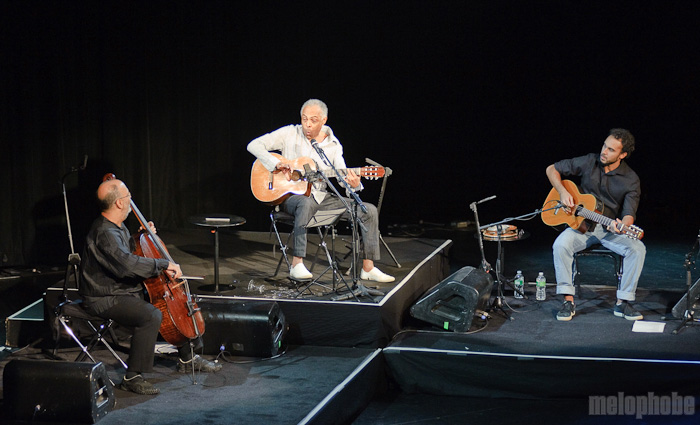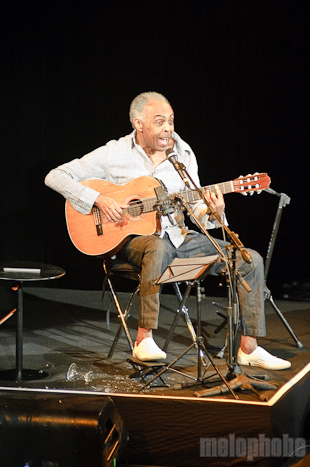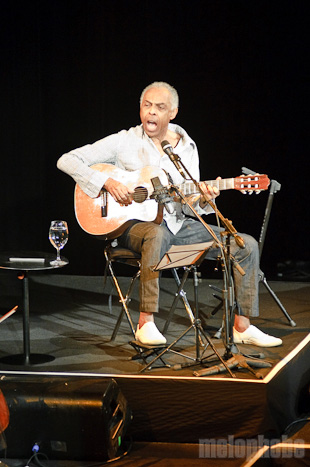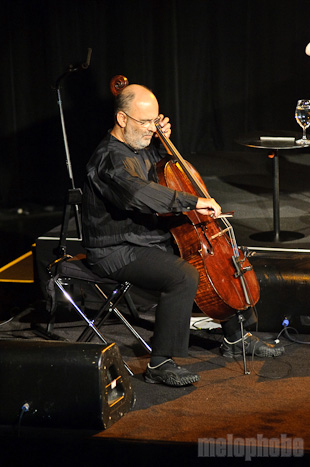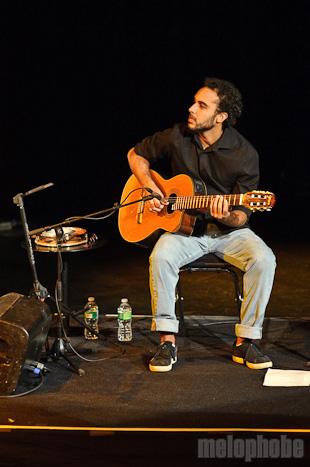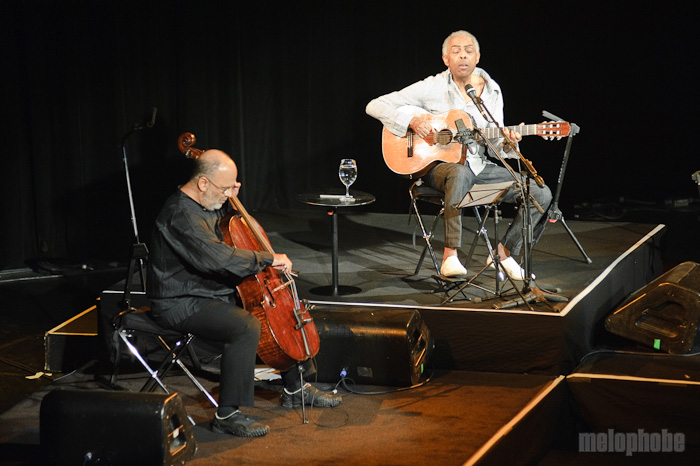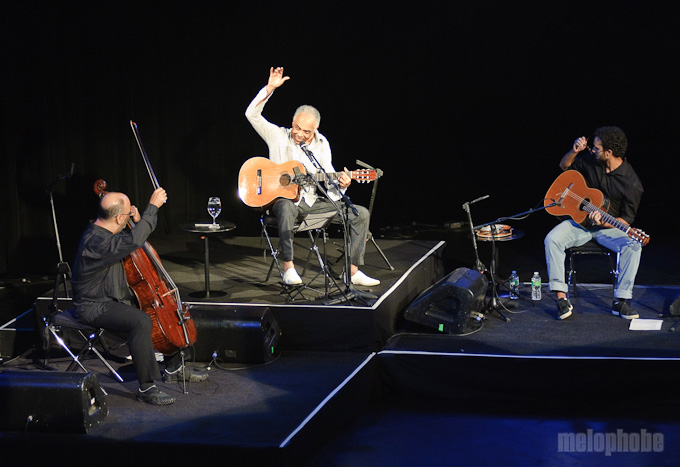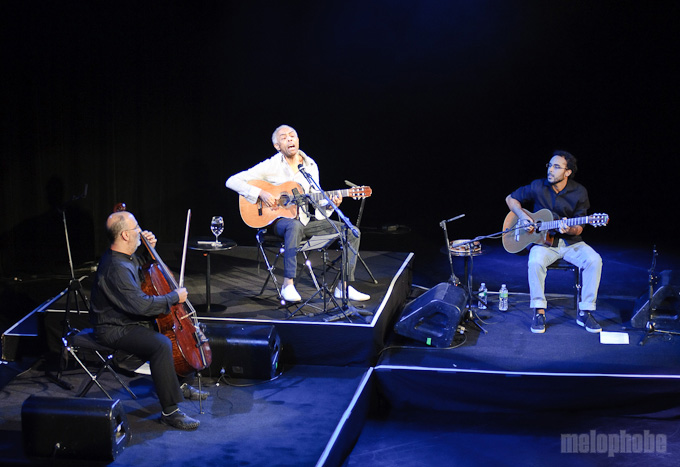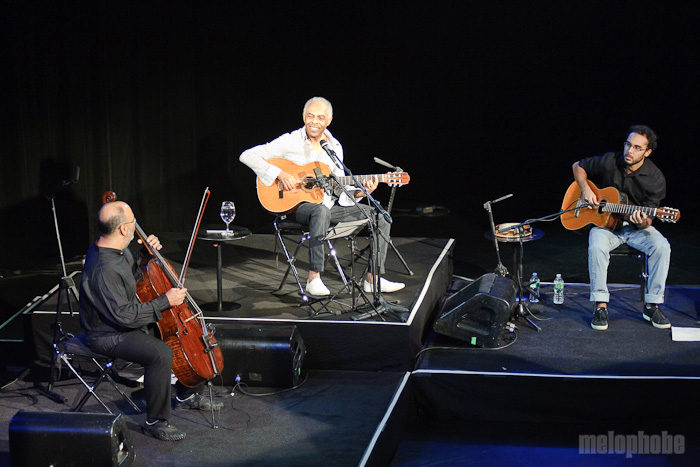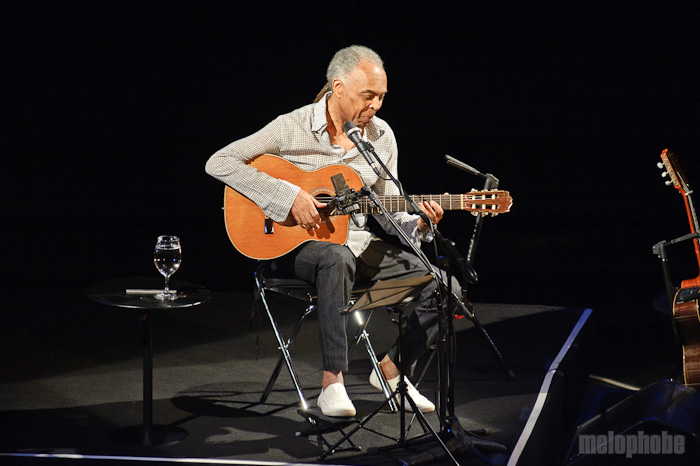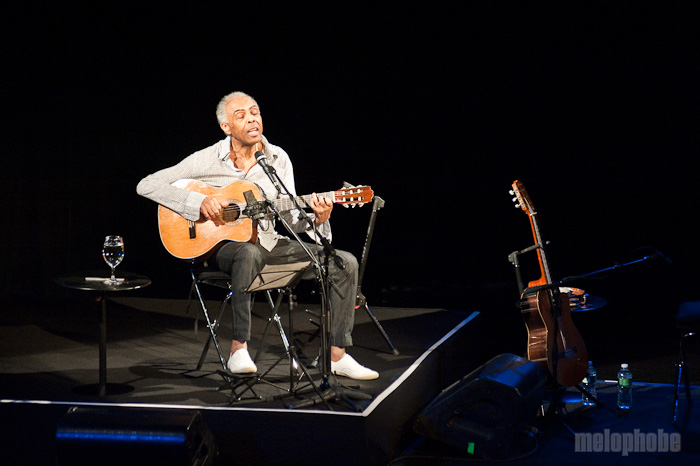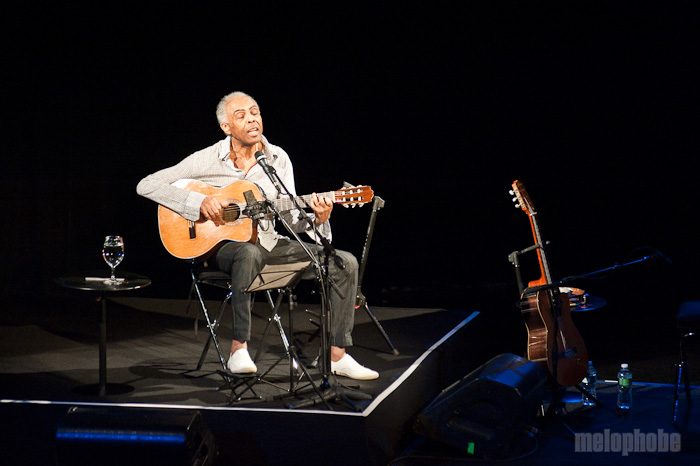
Legendary Brazilian artist Gilberto Gil brought his signature blend of traditional and experimental world music to the Nokia Theatre Times Square Thursday night. Billed as “The String Concert,” the evening featured the musical and political icon playing with his son, guitarist Bem Gil, and cellist-producer Jacques Morelenbaum. Unfortunately, we caught only three songs for photographing before we were escorted out of the sold-out, seated event, but the short performance we witnessed was nonetheless memorable. With just fingers on strings, the trio sketched out the sound of a much larger ensemble. The rhythmic plucking and strumming hinted at samba-style percussion, jazzy swing, rock and funk. As advertised, the performance was pleasantly intimate: modest, but by no means simple.
Though we can't provide a full review of the night, perhaps we can offer an introduction to the living legend whose ambitions are profoundly extra-musical:
Gilberto Gil led Brazil’s Tropicália, or Tropicalismo, movement along with fellow musician Caetano Veloso and their band with songwriter Tom Zé, Gal Costa, Os Mutantes, Milton Nascimento, and poets Torquato Neto and José Carlos Capinan. The Tropicália movement grew from the conflict between the Brazilian people and a US-appointed right-wing military regime that seized power of Brazil’s government in a violent coup in 1964.
At its inception, Tropicália wasn’t merely a musical movement. It encompassed complex sociopolitical issues with elements of theatre, poetry, film, philosophy, music, and many other forms. Musically, Tropicália blended distinct ingredients of bossa nova, American blues and jazz, British psychedelic rock, avant-garde samba, funk, soul, Bahian folk, African influences, and Portuguese fado (a form which contains songs and lyrics concentrated on the desires and frustrations of everyday people). The 1968 collaboration album, Tropicália: ou Panis et Circenses, is considered the musical manifesto of the movement. It’s characterized by unusual time signatures, experimental song structures and socially conscious lyrics.
As the movement grew, the opposing dictatorship recognized that outspoken criticism from enlightened Tropicália artists threatened its authoritative power. As a result, on December 27, 1969, agents of the military police arrested Gilberto Gil and incarcerated him on false charges. He was jailed for months before being exiled in London, England in 1969. Gil returned to Brazil three years later, but the Tropicália movement effectively ended in his absence.
Although it originally attained little notice outside of Brazil, Tropicália artists have continually grown in popularity and are often cited as an influence by rock musicians such as David Byrne of Talking Heads, Beck, and Of Montreal. Since the Tropicália era, Gilberto Gil has moved onto other musical projects. However, he has continued to pursue a political path, recently serving as Brazil’s Minister of Culture.