Note: At the tour's request, we did not photograph Interpol.
Some concerts are about details; others are about the overall experience. With the latter, individual songs cease to be important, and the overall mood and feeling of the show is really what stands out. While that sounds like a romantic and lofty statement, it can also be the telltale sign of mediocrity. School of Seven Bells started off an evening at the Roseland by bringing something pleasant and mildly rewarding, only to be brought up at the heels by a thoroughly mediocre Interpol.
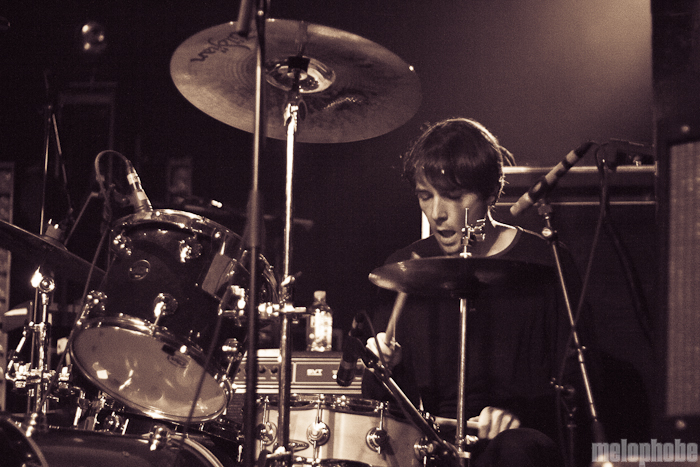
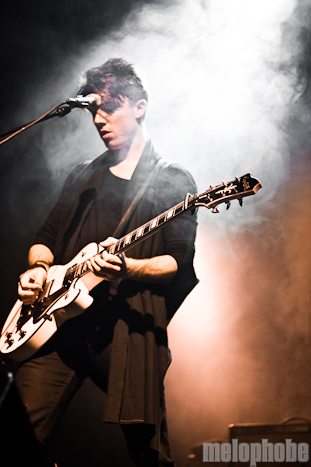
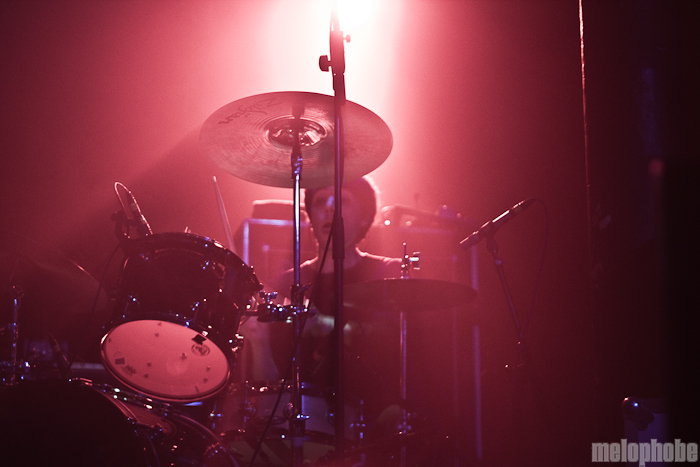
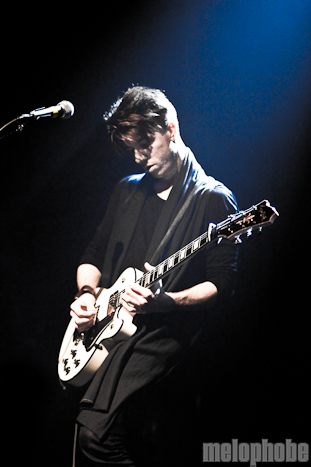
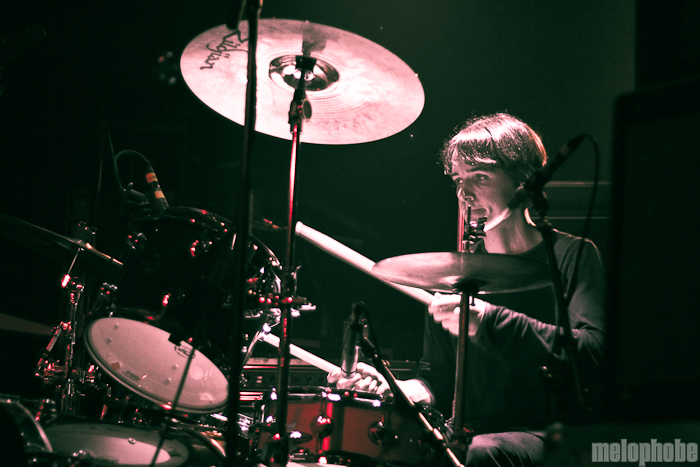
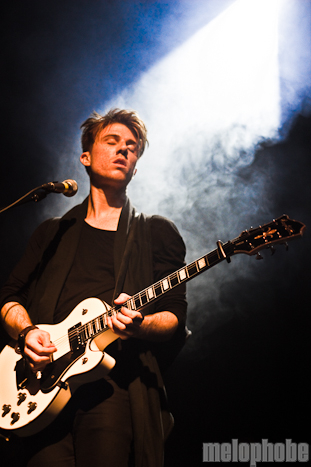
With a concert like this, going through the set song-by-song and explaining the subtle differences in tone and pitch really isn’t going to help anyone. In the case of School of Seven Bells, all of their songs seemed to blend together into a pleasant, but somewhat underwhelming musical atmosphere. Singer and guitarist Alejandra Deheza has a great voice and lively stage presence, but it bordered on fidgety as she shook her hair in a rather stiff, mechanical fashion at least a thousand times throughout the show.
The band suffered in part from a bad space. While their sound fit surprisingly well within the cold, cavernous walls of the Roseland, the quality of that sound left a lot to be desired. Dehaza’s vocals were lost in a cacophony of drums and bass, punching the delicacy that makes their music so balanced and charming right out of the equation.
It’s worth noting that this is probably the first time the band has played in Portland since the departure of Claudia Dehaza, the identical twin to Alejandra. As the group wrote all of their songs collaboratively, it will be interesting to see where they take their music from here.
I’d like to be able to say more about Interpol, but I had to leave after 20 minutes. Why? Was I tired? Well, yes, but that wasn’t what drove me out into the cold. What did was singer Paul Banks’ voice. Admittedly, Interpol can be an acquired taste. His voice is certainly not for everyone, but I’ve never had a problem with it before. Hearing it live, though, was a different story. Any shred of soul or feeling that had been there before, seemed to have been sucked out and replaced by and empty, nasally version of the original. Their light show may have looked cool, and guitarist Daniel Kessler continues to own any stage he sets foot on, but it was all eclipsed by how phenomenally empty everything sounded.
Live music is not necessarily about movement, as many have argued. In fact, it doesn’t even have to be about enthusiasm (though having some as a musician does help sometimes). What it comes down to is performance and being a compelling performer, both in how you handle yourself on stage and how your sound comes across. Physically, Interpol does OK, but some serious work need to be put into how their sound comes across to the audience before I ever think about seeing them again.