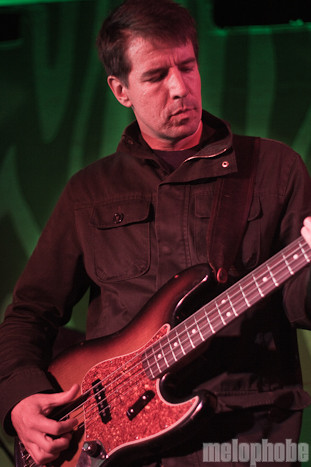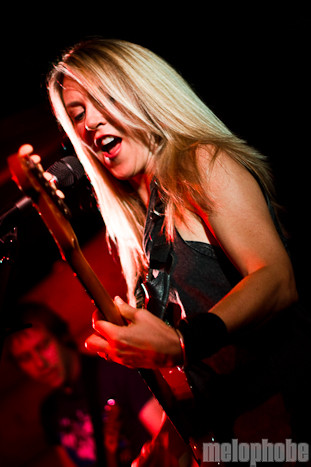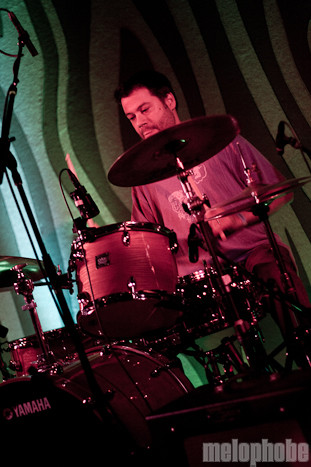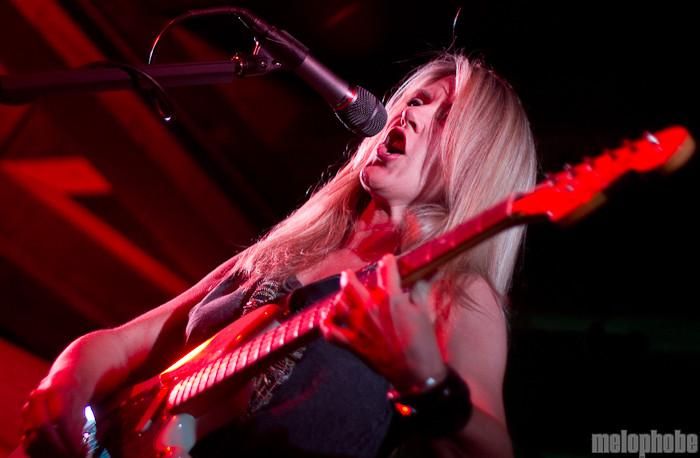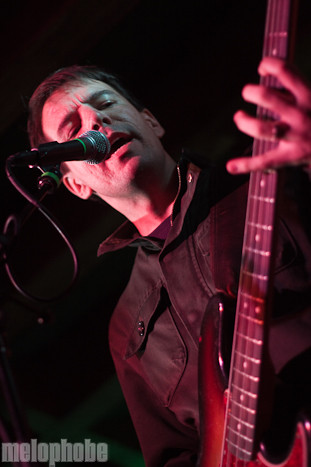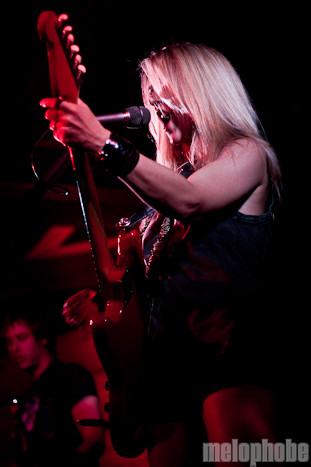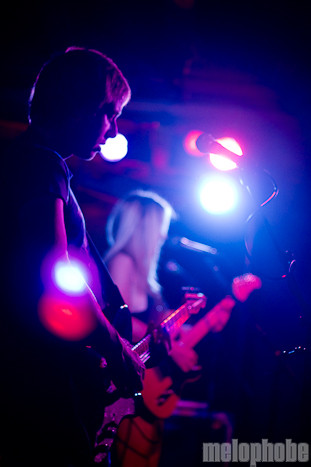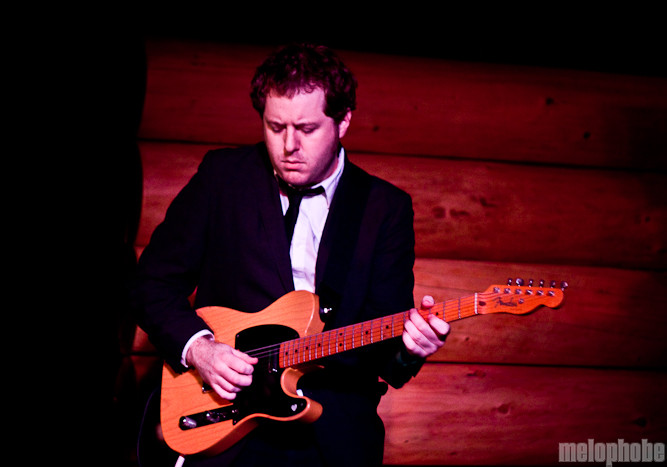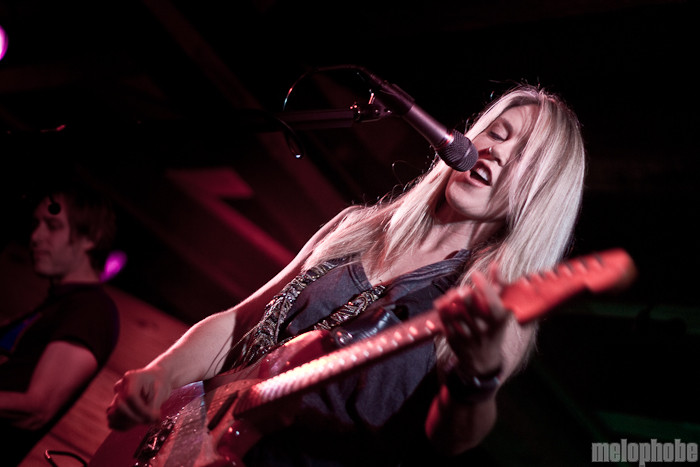
“Even when I was seventeen,” I loved Liz Phair. There was something so pure and honest about the songs she made – something that captured everything I was feeling and couldn’t put into words. Flash forward a decade and I am sitting at Doug Fir, waiting for her to go on. She doesn’t tour frequently, and I’ve only seen her once before, when she played a mere eight songs prior to a Flaming Lips set in 2003. There’s a long setup period following the poppy opening band, The Ravishers. The venue is crowded and humming with anticipation. Suddenly the room erupts with cheers. The diminutive Ms. Phair emerges from backstage sporting a tank top and shorts, despite the notoriously freezing Doug Fir temperature. She approaches the microphone and greets us as her backing band sets up. She briefly surveys the (mostly older) crowd, and with a knowing look on her face, begins her set.
The first song, “Supernova,” is polished and perfect. Her voice, free of the digital pitch correction that has diluted her recent work, floats across the room and infects us with its deep beauty. Captivated, I begin to sing along. She croons, “Your kisses are as wicked as an M-16;” this song has a special place in my heart, and is the perfect addition to any mix you would make to not-so-subtly express your affection for someone. Phair completes the song and begins to talk to the audience – a theme that will continue throughout the night. An accessory becomes entangled in her guitar strings, and she jokes about having technical difficulties due to fashion. With the problem fixed, she launches into “6’1.” She plays it flawlessly, and the audience is entranced. “More vocals!” someone yells. “I don’t sing that loudly,” she responds, “but I’ll see what I can do.”
With the sound adjusted, she gives us a fan favorite – “Divorce Song.” Phair’s strength has always been her ability to craft brilliant lyrics that teeter between brutally emotional and deliciously obscene, provocative but never crass. No truer statement exists than “it’s harder to be friends than lovers, and you shouldn’t try to mix the two/because if you do it and you’re still unhappy, then you know that the problem is you.” She is a prolific writer, and the words to all these songs are scratched into my memory after years of acting as an invaluable soundtrack for the best and worst pieces of my life. Liz Phair sings with a smirk, as if she’s got a juicy secret and will only share it if you beg her. She builds a rich atmosphere with her comfortable banter and inimitable stage presence. There is electricity in the air as this third song comes to a close, like a storm is brewing above us.
Phair plays “May Queen” and “Never Said” – more classics from Exile in Guyville – with the band singing backing vocals on the latter song. She switches to her cherry red guitar, featured in many a photo shoot, and asks the audience whether it’s true that a lot of serial killers are from Portland. “Interesting segue,” she says. I have a second to ponder what that means before she launches into the beginning licks of “Johnny Feelgood” and I start to jump up and down. “Johnny Feelgood” was the first Liz Phair song I ever heard, and it came to me at just the right moment. The year it was released, I was fifteen years old and had just had my heart broken by a guy named John. This song consoled me. “I hate him all the time,” Phair sings, with her eyes closed, “but I still get up when he knocks me down.” We sing with her. I don’t care that people can hear me; I am lost in the moment. This is the stuff that composes teenage fantasies.
The next song, “Nashville,” about a new relationship and another favorite of mine, features the line, “nobody sparkles like you.” Once it’s over, she shifts gears and gives us something from her most recent album, Funstyle, which has perplexed even the most dedicated fans and received scathing feedback from nearly every reviewer. In this setting, though, “And He Slayed Her” is fresh and surprisingly reminiscent of her older work. The crowd seems intrigued, but they clearly want familiar tunes from her first three albums. She returns to Whitechocolatespaceegg by playing “Polyester Bride” - a song about a bartender and his unrequited love for a patron who comes in to complain about her relationship woes. Phair is at her best when she is raw like this, and the ambiance continues to improve after each song.
Doug Fir is truly the perfect venue. It’s small and intimate, and if I close my eyes I feel as if I’ve won some magical contest where Liz Phair is to play all of my favorite songs in my living room. She begins playing “Perfect World,” and the absolute desperation of my younger years comes flooding back to me. “I wanna be cool, tall, vulnerable, and luscious,” she sings. Was she reading my mind? There was a time when those words swirled through my head nearly every day, and they never stop being true. After playing “Mesmerizing,” she tells us that if we listen closely to the end of the recording, we’ll hear the whining of a dog named Piggy who was present in the studio during the Exile in Guyville sessions. At this point, she knows we are waiting for something. There is one song we want, and she isn’t going to let us have it just yet. As we stand in our collective holding pattern, she gives us “Bangladesh,” another track from Funstyle. She informs us that the album is being mastered and will be much better in its final form. The vocal range requirements this song forces her to hit lead her to say, “that’s a motherfucker to sing!” when it’s finished.
“Extraordinary,” one of two singles from her 2003 self-titled album, makes an appearance. This song or its twin, “Why Can’t I,” was used in the trailer for nearly every romantic comedy released that year. Due to their drastic departure from her earlier work, they are representative of what many fans consider Phair’s selling out. We are presented with “Stratford-on-Guy,” and the initial set is beginning to come to a close. She’s got one more song, and we know what it has to be. At last, Phair plays the intro to “Fuck and Run,” perhaps the most infamous track in her catalog, and it becomes an expletive-laden sing-along. A cacophony of cheers fills the room as she walks off the stage.
She returns shortly and tells us she will “hack through” a fan request from the previous night. “You’re Guyville fans, right?” she asks. “If you guys know it better than me, sing along!” The song in question is “Soap Star Joe,” and she plays it well. After it’s over, the words “Girly Sound” escape her lips and I go completely bonkers. For Liz Phair fans, Girly Sound is the stuff of legend, whispered about as if it were some illicit drug. Many of its songs were reworked for Exile in Guyville, but most remain unreleased some 20 years after being recorded. With the advent of online file sharing, though, half the audience knows them anyway. She liked to retool classics during the Girly Sound era, which shows in the semi-cover of “Wild Thing” she plays. She follows it with “Black Market White Baby Dealer.” Switching guitars again, she tells us the wonderfully perverse “Flower” will be her final song, and she invites audience members to join her onstage to sing the high part if familiar enough to do so. My voice is high, and I could sing that song in my sleep, but I hesitate and my chance is gone. The volunteers are nervous and can’t seem to harmonize, but they pull it together and the song becomes a beautiful collaborative effort between Phair and four fans who are having the best moment of their lives.
In all, she’s played the majority of Exile in Guyville with a smattering of Whip-Smart and Whitechocolatespaceegg. With the performance over, Phair thanks the audience and retreats backstage. Attendees suck down their remaining cocktails and shuffle out the door, but I have a feeling. I make my way closer to the stage, carrying the vinyl copy of Whitechocolatespaceegg I’ve brought along just in case there’s a chance encounter. With the room nearly empty, she reappears, coffee in hand, to greet the small group of stragglers. Despite creating one of the most critically-acclaimed albums of the '90s and gracing the covers of major magazines, Liz Phair is exceptionally nice, humble, and gracious. She asks the name of each person who approaches her, and takes great care in spelling mine correctly as she sharpies it onto the album cover. She looks phenomenal even up close; incredible talent must be the secret to eternal youth. Lost in total euphoria, I make my way home.