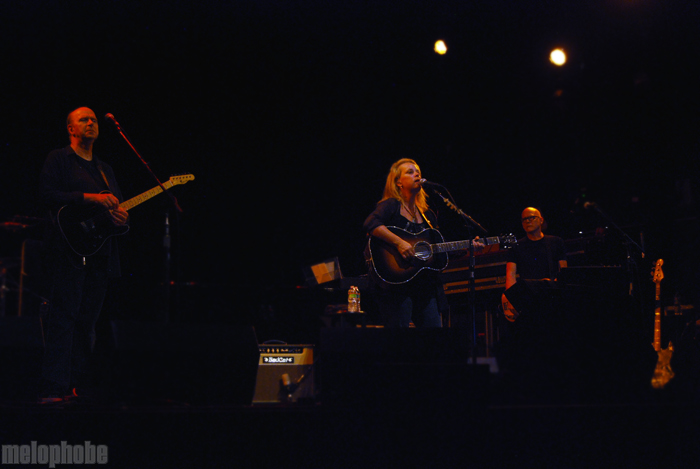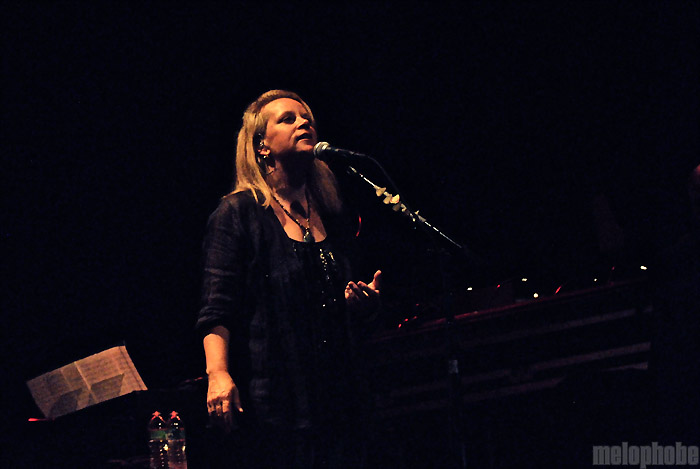
Despite nominal and largely inapposite stylistic differences, the two headliners were well matched: two musical recluses less interested in the zeitgeist or stylistic conventions than songcraft, whether interpretation (Madeleine Peyroux) or songwriting (Mary Chapin Carpenter). Another good pairing was the Berklee Performance Center, which has acoustics so fine, so pristine, I noticed the cool static wash of amplification at rest for the first time I can remember.
The sound was so clear that the fluttering shutter of my camera lens sounded like a pin dropping, loudly. Taking photos at concerts is necessarily intrusive, but usually only with respect to sightlines and flashes; it is an odd shock to wonder if everyone else is wondering where the clicking is coming from. I started holding off until I could hope to be drowned out by the louder moments.
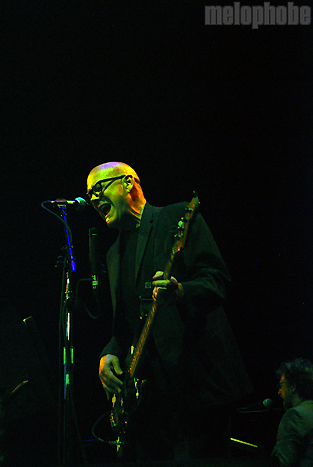
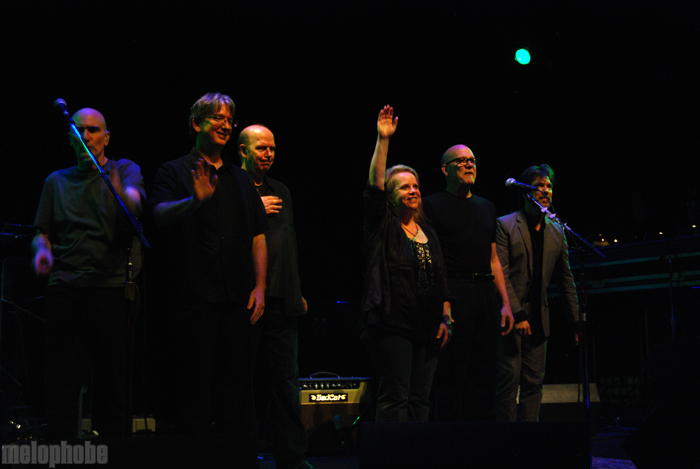
Or maybe my discomfort was due to the fact that the music on offer is not performed for show in any sense but auditory. No one rocks out, even rudimentarily, with the possible exception of Dickson, who played bass in Carpenter’s band and looks like a balded Mike Mills (a good look, given that he produced some of REM’s earliest and best work). The musicians wore the best dictionary definition of “street clothes” I can imagine, at least as far as middle-aged white folks go (the black-sheathed Dixon the exception again). The looks were not at all the point. The sound was, Carpenter’s earthed and soothing voice, and her lyrics detailed and quietly intriguing as an old family photo.
Carpenter’s later albums, like those of Suzanne Vega and Kate Bush and, ahem, Wilco, have been dedicated to chronicling the reflectively slow, subtle dramas of domesticity. This can give her songs an oddly flat arc: “I am a Town” takes the titular conceit and examines it from every possible angle, but, oddly for a song about travel, never really goes anywhere. This is the greatest fallacy in the “country” label – she does not so much tell stories as express ideas, affirm convictions. In that sense, she is closer to a secular, homely gospel.
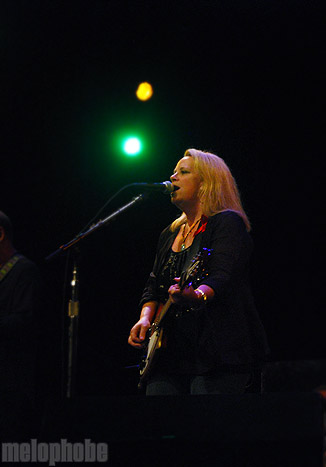
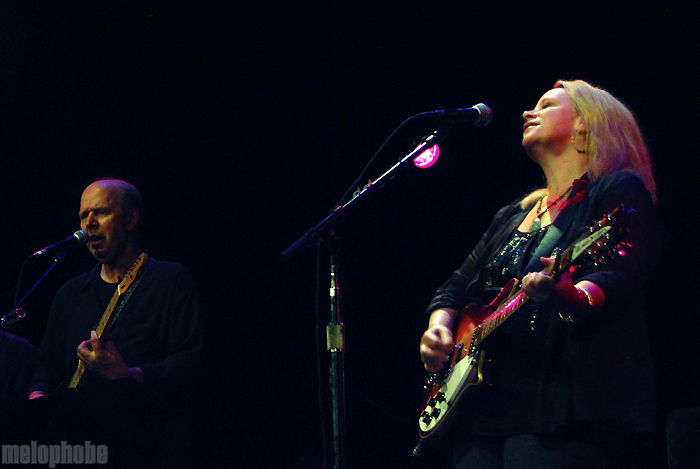
This works well when Carpenter trades acoustic guitar for Rickenbacker and invests her abundant gift for melody in jangling tunes that you could imagine REM covering. Introducing “Passionate Kisses,” Carpenter – an understated, deadpan raconteur – told a story about Lyle Lovett claiming to have felt her up in a TV interview, dryly marveling, “He has such a rich imagination!”
Reviewing my photos, it is all but impossible to find a shot in which Carpenter is not smiling – ruefully, thoughtfully, chuckling, beatifically, no matter. Carpenter’s utter absence of cynicism comes as a shocking contrast to the current surfeit of hipster irony, but it sounds a lot more eye-rolling in the abstract than in person. Introducing “The Calling,” a song about pursuing one’s purpose “knowing there’s no other way,” Carpenter described her sister, who runs 100-mile races: “I don’t know how I’m related to her. She ran one today. Presumably she’s still alive”; a friend who builds schools in rural Guatemala; then deadpanned: “Then there’s Sarah Palin.” And looked down, a sneaky grin playing at the corners of her mouth.
Peyroux, who has been stamped a “jazz” singer much as Carpenter has been deemed “country” for largely cosmetic reasons, opened the evening with a similarly accomplished, precise and understated performance. Her rendering of Leonard Cohen’s epic “Dance Me To The End of Love” shed some of the apocalyptic grit of Cohen and Thalia Zedek (and several verses), using the song as a gorgeously gloomy canvas for Peyroux’s astonishing mastery of her voice, swooping into the unwonted crannies beneath and behind the melody, as though seeking a way out of doom.