I thought I liked the Books. Before I saw them perform at the Aladdin Theatre, though, I had no idea. No idea at all. I thought I liked Black Heart Procession, too. That still holds, but their performance in the opening slot on Friday night, unfortunately, left much to be desired. The evening began on a rather promising note. I arrived right at 8pm, the slated start time for the show. Upon entering the theater at a few minutes after the hour, I was relieved to see that the performance hadn’t started yet. Onstage was only a lone projector screen, upon which a slideshow featuring images of clocks played to the accompaniment of, yeah, basic clock noises. I’ve been to my share of arena rock shows featuring silly, basically mindless theatrics by way of introduction, and this little gesture to artistic pretension was more or less in the same vein. Except, of course, there is a difference in scope – size, budget, and so forth – that seemed to cast this one little projection screen as something of a farce. Viewed in this light--as an indie take on corporate big-headedness--the incessant clicking clock images were rather refreshing. So, too, was Black Heart Procession, when they eventually took the stage.
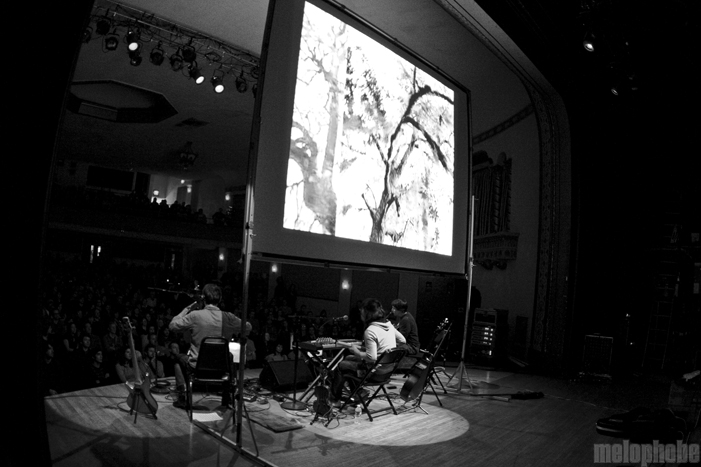
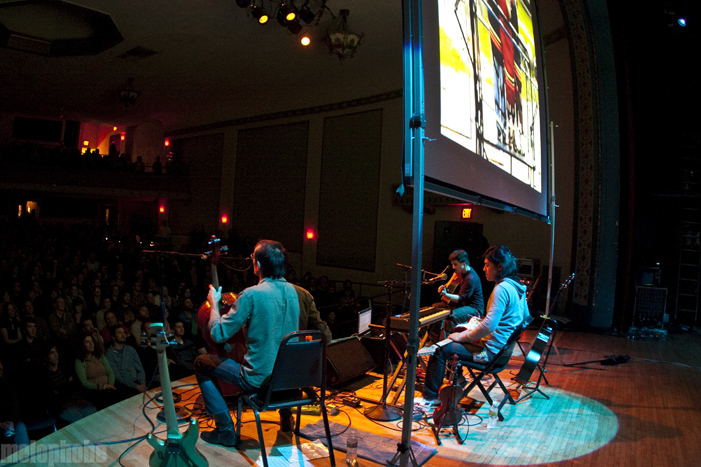
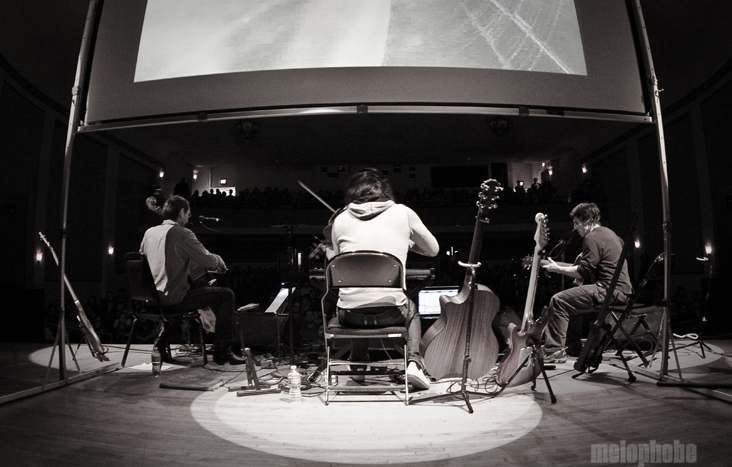
Black Heart Procession’s music--beautiful, deep, and resonant--filled the hushed room, evoking a mood of complacent melancholy. The images flashing on the screen behind them got more varied, and though they weren’t in any way synched to the music–in fact they cycled through perhaps three or four times over the course of the set–they enhanced the emotive power of the songs. Unfortunately, by about the fifth song, it was becoming evident that variety was not on offer in Black Heart Procession’s set. The two musicians, Pall Jenkins and Tobias Nathaniel, remained seated throughout the set, only displaying the faintest sign of life when both craned their necks toward the projector screen to see what image had elicited giggles from the audience. Taken in small doses, this lack of showmanship would have been unobjectionable, but even the brief 40-minute set was much too long to watch two seemingly unenthusiastic musicians play songs that, though lovely, lacked any kind of variety whatsoever. Call it a wash, then. It would be worse than nitpicky to have a bad time in spite of the undeniable quality of the music; on the other hand, room for improvement was ample. The band received a healthy round of applause at the conclusion of their set, but the general speed with which the audience got up and retreated for the lobby suggested a pervasive restlessness that must be chalked up to the performance.
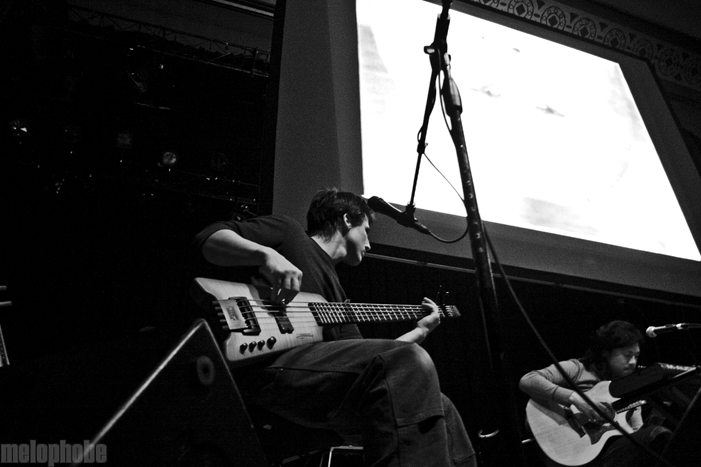
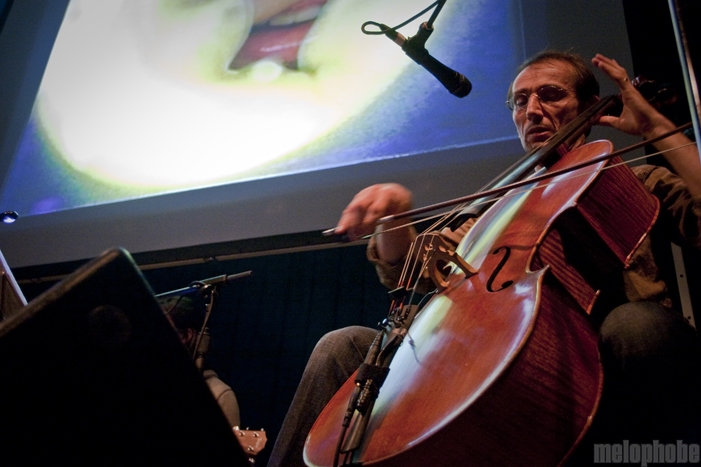
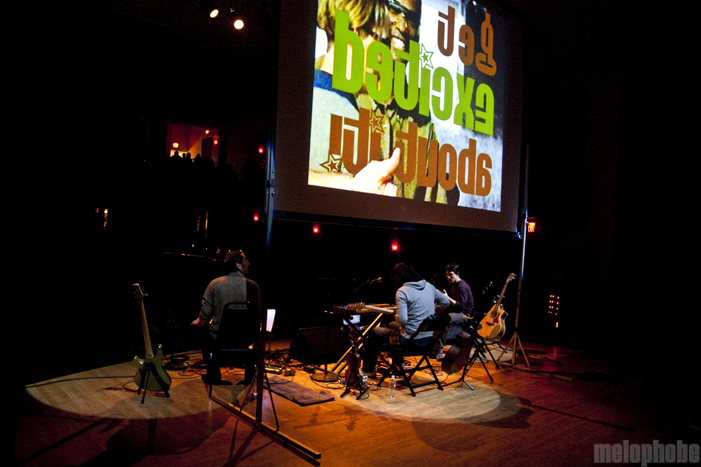
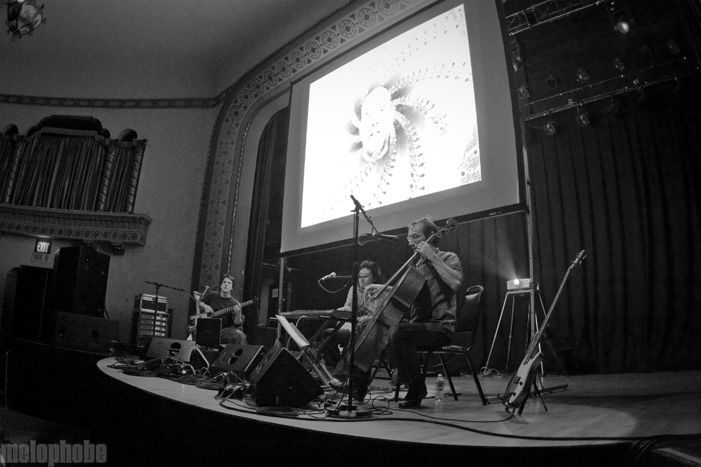
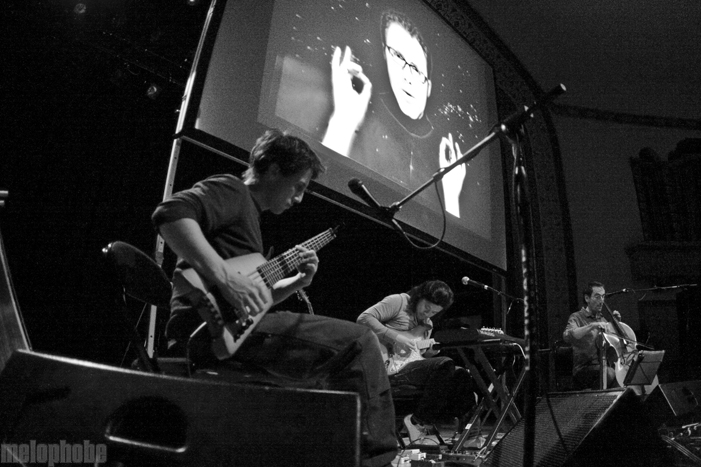
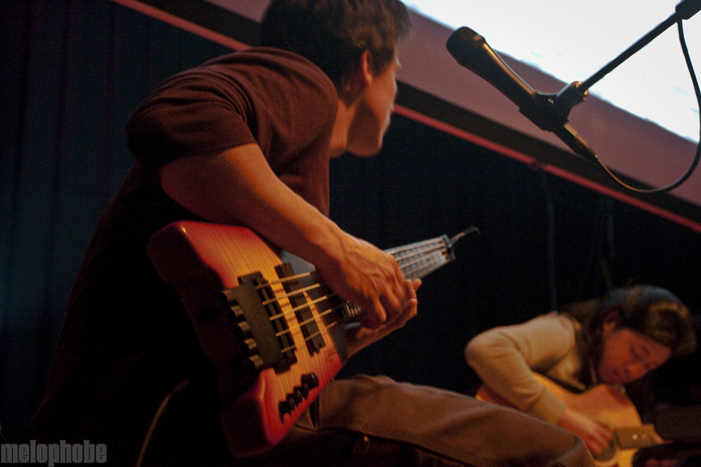
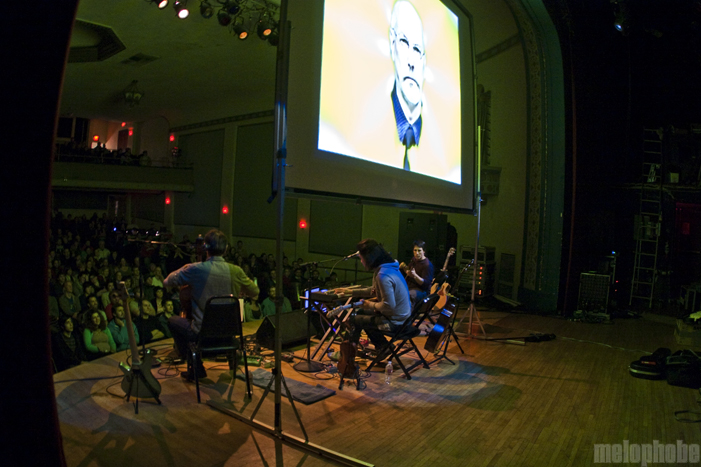
The Books, in that regard, were the antithesis of Black Heart Procession. Admittedly, some comparisons were obvious. The three members–Nick Zammuto and Paul de Jong, plus new addition Gene Back--likewise kept to their seats for the duration of their performance. They also made use of the projection screen, as is their habit. But whereas Black Heart Procession merely cycled through images, some humorous, others heartbreaking, the Books took full advantage of the technology to display videos meticulously synched to each song. That element of the show actually preceded the performance, with a floating head, cruelly disembodied by clever use of a blue screen, advising the audience on the methods of hypnotics. He was soon followed by several other disembodied hypnotist heads, their instruction becoming progressively more bizarre to the point of absurdity. Well before the Books started playing, then, much of the audience had succumbed to laughter. It was a strange note on which to begin the set, but then, humor was a theme that, in subtle fashion, was carried throughout. The first song, “I didn’t Know That,” was introduced as being “about the wonderful and mysterious game of golf.” Appropriately, it was accompanied by an outrageously bad video–so terrible it was funny, really–about golf instruction.
The Books’ 2010 release, The Way Out, makes creative use of a mish-mash of what might be termed “found sounds.” The most memorable track, “A Cold Freezin’ Night,” notably features the voices of children expressing a litany of cruelties to one another. It can make for disturbing listening, but as presented in concert, the song was transformed into something of a black comedy, an examination of the sheer silliness of childhood meanness from the safe distance of adulthood. As Zammuto explained it, the vocal tracks were taken from Talkboy tapes the band found at various thrift stores across the country while on tour. Talkboy, for the uninitiated, was a handheld cassette recorder that apparently enjoyed some popularity in the early ‘90s. Macaulay Culkin dicked around with one in "Home Alone 2," but we won’t go into that. In any case, the performance, which among other things featured a transcription of the vocal tracks incorporated into the video, was one of the highlights of the night. The abrupt start and stops of the music, which is repeatedly interrupted to make way for a child saying things like, “You’re such an idiot!” or, “I wish I was a boy,” were impressively handled by the musicians, who alternated pauses with bursts of furious playing throughout the entire song. When a particularly troubled child tells his companion that he can kill him “anyway I want to…probably by cutting your toes off and working my way up – towards your brain!” it is not meanness that you hear, but absurdity – helped, no doubt, by the appropriately juvenile visual element.
If I were inclined to complain, I’d note that the video screen served to distract one’s attention from the musicians, who were well worth watching on their own. But that criticism involves ignoring the fascinating effect the videography had on the performance, which is surely something not to be sacrificed. The show operated, to a large degree, as a multimedia presentation, which suited the avant-garde tendencies of the Books. It was only when the band toned down the experimentalism to finish with a stunning rendition of Nick Drake’s “Cello Song,” though, that they fully established their mastery. They had received enthusiastic applause throughout the night, including a standing ovation when they left for the encore break. But the reception to close the night was unparalleled. And, of course, it was much deserved. To listen to any of the Books’ albums is to be aware of their creative energy, but to see them live carries the experience to another level. It was, in the final analysis, an experience I was grateful not to have missed.