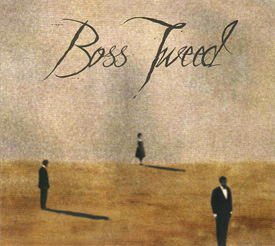
The album kicks off with the sultry, slow and brooding blues of “12th Street,” taking you to the back corner =table at a smoky lower-level bar in Manhattan, everything bathed in dense red light. Sills prays “I hope you remember that/Because I’ve forgotten about it,” dismissing what can only be unpleasant repressed memories from a not-so-distant past. The pace quickly picks up with the undeniably catchy “Pretty Violent,” where Sills belts out “There’s a storm brewing over your actions/This tempest has taken my name/I’m about to create an inferno from your flame.” This could be the finest song on the album, where Egan’s layered guitar work during the bridge is powerfully underscored by the methodical rhythm section, leading to a strong, soulful Sills finish. The listener is then treated to the minor-key rockabilly farewell bid in “Real Good Sell” and the downright funky baseline in “Then It Hits You.”
The minute-plus beautiful acoustic “Cleanin’ Upsa Ditty” divides the album neatly in half; Egan and Sills croon “Think of what you started/Now we’re both broken hearted/Never got around to cleaning up” as the song ends in a psychedelic shimmer. The second half of the album begins with the country-tinged “After Awhile” (sung by Egan in his charming tenor, with Sills’ joining the chorus with her powerfully undercutting harmonies) and the breakneck pace and dark imagery of “Hellbent,” with Reed hammering out the beat while Sills’ insistent bass line provides the perfect backdrop for Egan’s reverb-drenched single-string riffing. Sills sings “I told him ‘never’/But it sounded like ‘once more’/He’s hellbent on gettin’ in the door,” as the listener envisions a potentially explosive situation where some uninvited person is making something more than a nuisance of himself.
The straightforward blues delivery of the verses of “Self Made Man” sound like a cover of a lost Muddy Waters song until Egan’s oversaturated guitar takes the song from blues to rock in the chorus. “No waiting ’round for any winning number/Holy roller, deal made with the devil’s left hand man,” Sills sings in this inventive blues revival.
While the somewhat bizarre “Pontchartrain” doesn’t seem to meld with the rest of the album (likewise the traffic noises of the opening track, “GWB”), it makes a nice transition to the mellow acoustic backed almost-country closer “Goes Like Nothing” (complete with slide guitar overdubs). This is the most delicate and beautifully composed song on the album, a fitting end to show that blues and rockabilly don’t come close to encompassing the group’s potential. If they can produce this well-written composition almost as an afterthought as the last track, the promise of their future work is certainly compelling.
This is music which feels as though it should have been written in another decade, though Boss Tweed is too versatile to be pigeon-holed as a rockabilly or blues revival band. These are clearly influences, but the work taken as a whole is an important statement from a young band just beginning to show their stuff in bridging all these genres and making them their own. Certainly, the album is powerful enough to be able to transport you from that smoky basement bar in “12th Street” all the way to the final track, where “California dust it goes like nothing right into the sky.” After hearing the album through, this is a voyage that you will want to take more than once.
Boss Tweed can be found on
Carolyn Sills and the Poor Man’s Roses, Sills’ Patsy Cline cover band, (check out Back In Baby’s Arms and you might forget you’re not listening to Patsy herself) can be found at http://www.myspace.com/thepoormansroses
Carolyn Sills’ solo can be found at http://www.carolynsills.com