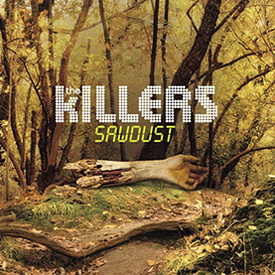
The Killers, a drop-dead singles band, put more energy, or at least glee, into their B-sides than most – with such high peaks, they are less fussy about anything except the gargantuan songs. It is no surprise then that the best thing on the whole bang shoot is the murkiness of “Tranquilize” (aka The New Track featuring Lou Reed), which suggests that an album might be squeezed from a Killers stint as Lou’s avatar. Flowers has a similar eerie sonority as Antony Hegarty, the previous incumbent and, like Antony, can’t match the specific gravity of Reed’s wizened croak.
And then there’s those bones. The rerecording of some of the songs imparts a woozy sense of disorientation. Was “Glamorous Indie Rock and Roll” less overbearingly awful in its previous incarnation, or have I simply come entirely to my senses? Was the riff from U2’s own B-side “Holy Joe” always embedded in “Who Let You Go?”? Either way, it makes perfect sense, the killer spawn returning to the mothership, the lizard glam only faintly more ironic in the aspirations of the former.
And come now, “Where The White Boys Dance”? Flowers bungles notes – his delivery suits vocoder-esque declamations a but has little patience for subtlety – but the real horror is that god-awful title. Does anyone actually want to find the place where the white boys run and play? Is this, like Flowers’ recent moustache, all part of an ongoing campaign to cut their poster-boy status with a loathsome loucheness? U2 tried this trick too, and Flowers has a passing resemblance to Fly-era Bono, making menacingly empty gestures while whats-his-face the guitarist dutifully replicates those four-note Edge figures.
“Romeo and Juliet,” meanwhile, splits the difference between Indigo Girls and Dire Straits, which makes perfect sense given The Killers’ stadium-ready shininess and their incipient po-facedness. But it also reveals the weakness in what could have been the most potent song on the album. Over a simple accompaniment that could be a talented high school band working from internet tablature, Flowers sounds more like a regular guy than anywhere else – worn down, with a story to tell. The effect is decidedly mixed – there is no catch in his voice like Amy Ray’s, nor can he dispel the bombast sufficiently to muster the enigmatic bashfulness of Knopfler. After those magnificent singles of coy declamation, Flowers’ nakedness sounds merely fussy, as if it was just another one of his deals.
MP3 download available on