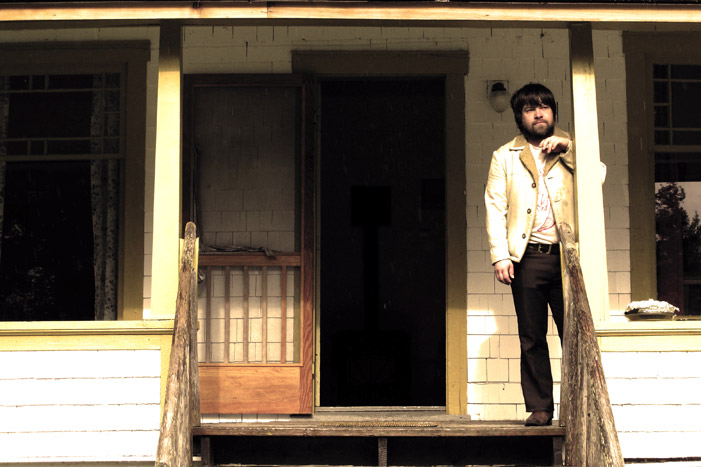
After a year of experimenting with different recording methods, Jesse Lortz found a home for his solo music in a cabin alongside friends. Recently released through Sacred Bones, The World Is Just a Shape To Fill the Night is Lortz's debut under the moniker Case Studies, which he hopes to use not only as a venue for music, but also for the visual art he's been itching to create.
Danielle Fowler for melophobe: I’ve listened to the album a couple times through already, and I really liked it, especially the opening track. It sounds like it had 3/4 time and that time signature always seems to grab me.
JL: Waltzes are easy.
melophobe: And so pretty! I notice that you’ve been in quite a few bands in your musical career. A lot of publications refer to you as prolific. Is there a time you can remember when that might’ve started or when that adjective might cease to apply?
JL: Prolific? You mean, I’ve written a lot of songs? I don’t really know how to answer that. If I am prolific, I guess I’ll stop when I stop writing songs. Music from my earlier bands were just kind of party music and I had a hard time writing that stuff. One of my bands, The Fee Fi Fo Fums, this punk band or whatever, was supposed to do a 7-inch with this guy who lived in Atlanta and ran a label called Rob’s House, and I just couldn’t come up with another dumb punk song. So I tried to bail, but he said I couldn’t, so I wrote another kinda dumb punk song, but it was a little more depressing, I guess. Then I realized I could write other stuff than dumb punk songs. With Case Studies, I feel like I’ve been concentrating more on lyrical content. It just gets to this thing where you’re tired of writing the same song, and I even feel like that’s starting to happen now in a different way.
melophobe: Is that part of what helped you get started on Case Studies?
JL: Yeah, some of the Case Studies songs were going to be for the last The Dutchess and the Duke record, but we decided not to include them.
melophobe: In a press release about The World Is Just a Shape to Fill the Night, you mention that you've ventured into a lot of other creative outlets. Would you elaborate on this?
JL: I've just been drawing a lot more. I stopped drawing for a long time. I was in this sort of domestic situation that ate up a lot of time and energy, and then I was in this band that ate up a lot of time and energy. So I never had any time to focus on visual art or film. I have a lot of interests other than music. Even the music part of it is making it up, and then once it’s made up, you have to recreate it when you’re on tour– putting yourself back into experiencing it and re-feeling the song you wrote. I think I was really hyper-focused on playing music, which is the part of it that’s least fun for me. So intentionally this project is less going to be a touring job, like The Dutchess and the Duke was, and more like an art project that I don’t have to worry about. I can concentrate on writing better songs and also doing creative writing that doesn’t necessarily apply to music. Sacred Bones is really accommodating and supportive creatively, which I think helps a lot. Caleb, who runs Sacred Bones, has got a really great aesthetic and he always does kinda crazy, boutiquey packaging for limited edition runs, so I’m going to do some jewelry. It all still kind of revolves around music, because the projects are all by-products of the songs I’ve written, but I get to reinterpret them in different ways visually.
melophobe: What kind of mediums do you like to use?
JL: Mostly I’ve been getting into these Micron pens. I built a diorama for the record cover, which is pretty fun going into the library and picking out a bunch of photo files where they just have drawers and drawers and drawers of pictures that they clipped out of magazines. I did a drawing for the cover, and then Caleb wanted to do a special version for the limited edition versions. So I was like, “Oh, well, I’ll do this diorama!” and we can use that, but we ended up using it for all of them because it turned out really cool. That’s the picture that’s on the cover of the record.
melophobe: So with the limited edition, can we look forward to getting copies of prints, stories, or anything like that?
JL: Yeah, it’s pretty much just going to be this jewelry project. I think he only does 150 of those, so they’re pretty finite. I don’t really have a concrete vision of what it’s going to be, which is kind of cool for me. In the last band I was in, it just kind of took off without me, and I had to just hold on to it, because that’s how I was making my money. It got to be a real drag, so I’m intentionally keeping this not a real thing, I guess.
melophobe: Another thing I noticed in your statement was that the songs were recorded for a third time. What happened to the first two sessions?
JL: With the first, I did demos from my 8-track that I don’t know how to use properly, so they turned out sounding really, really distorted and shitty, but to me and the friends that I played it for, they’re the descendant versions of the songs, because they were recorded as I was making them up. Those might get released at some point. And then I went to Montana with the intention of recording them again, but I used the same recording machine to record themm so they turned out kind of usable. One of the tracks is from that session--I think the last song on the record.
melophobe: “The Day We Met”?
JL: Yeah. The third time was in Portland. We wanted to use a real studio, but it was just too clean sounding. So we ended up using a few tracks from that just to kind of round the songs out. So I guess the third or fourth time was how I wanted to do it in the beginning. Go to a cabin with some friends and have my friend record it. I probably should’ve just asked him in the beginning and saved myself a lot of time, and the record would’ve been out a year ago. But I think it’s good it took so long, because I cut quite a few songs that I wrote a couple years ago that aren’t really relevant now.
melophobe: How did including your friends change the dynamic of the record?
JL: Whenever the Dutchess and the Duke would record, which is my only experience with a working band, I guess, I would just go and record all the instruments and then Kimberly would come redo the vocals I gave her in, like, a day or something like that. It wasn’t really as interesting. You don’t get any sort of differences. On this record, I had some friends help arrange everything. It was just nice having people there who I care about and who care about me.
melophobe: Kind of like a family atmosphere?
JL: Yeah. It was just nice to share it.
melophobe: Sacred Bones’ description of the record said that the process was "spiritual." Any thoughts on in what way it was?
JL: When I write songs, it’s to figure something out about myself, or why I’m reacting to a situation in a certain way. I don’t even know it until after. I’ll write a song and think, “Oh, this feels good, this rhymes, this sounds good,” and then I’ll go back and listen to it and it’ll illuminate me to something that maybe I can’t explain. Even right now, talking about stuff is hard for me. It doesn’t really work that well. But if I write it as a song, it makes more sense to me. It’s the same with visual. It’s easier for me to communicate visually and through music than it is to speak or even talk with someone in my apartment or a close friend. So I think that these songs are conversations with myself. I’ve learned a lot about myself and think I need to change or let go of things. It’s kind of like automatic drawings. I’m still working within a structure and trying to say what I don’t really know how to say. Afterwards, it’s like, “Oh shit, okay.”
melophobe: And the world makes sense again.
JL: Exactly. It doesn’t make sense for long, but it makes a difference. So I think that’s the spiritual nature of this--that I’m recognizing that and using it as a tool.
melophobe: You mentioned that you weren’t sure if you would tour with this material. If you would, though, would there be any places that you absolutely would want to play?
JL: Yeah, I want to play in Chicago. Touring is a good excuse to visit friends, so there are times when I have a lot of friends that I haven’t seen in a year, because I haven’t toured. I’m probably going to set up a tour in September. I’m kind of itching to get out of town, and it’s a good way to travel where the travel pays for itself. I want to play in weird spots like churches and grain silos. My friend Julia, who sang on the record, told me about a place in Milwaukee. It’s kind of like a cave in the city--a holding area for water underground. I don’t want to play on big stages.
melophobe: The cave sounds like it would probably have great acoustics.
JL: Exactly. It’s really important for me because with The Dutchess and the Duke, it was becoming more of a paycheck, so it’s really important that I make it an interesting situation for myself where I’m not just going from town-to-town getting wasted and being bored, trying to put myself into a negative mindset so I can relate these songs in the way I feel they should. If I tour, I want it to be more of an experience for me. See new things and new places.
melophobe: An adventure!
JL: Exactly, an adventure! [laughs]
melophobe: Trolling the internet, I read a Q&A with you on a blog called Nome Alone, where you mentioned that you wished that you didn’t have any tattoos. Is there a story behind that?
JL: I got my tattoos all at once when I was a lot younger. I have them, so I’m stuck with them, and I guess the point of tattoos is to mark a certain time and place in a person’s life, so in that regard, they’re successful and functioning as reminders, but on the other hand, they’re from a time when I was uncertain about myself and uncertain about who I was and trying to define myself as real macho and hyper-masculine. In a way, they’re good, because they remind me of that, but it would be nice to not have a bunch of stupid shit all over my arms.
melophobe: In one regard, you’re redefining the term flesh memory, and in another regard, you live in Seattle where there are tons of awesome tattoo artists and you could get them reshaped into something else!
JL: If anything, I would probably rather cut my arms off.
melophobe: Or you could get bionic arms!
JL: Yeah, that is one solution. [laughs]
melophobe: I’m waiting for that to happen, when they make bionic limbs. Then people would be cutting off their limbs on purpose.
JL: That’s true. I think I’m probably going to get another one here soon from my friend who does tattoos. I’ve been trying to get her to give me one for free for awhile.
melophobe: What are you looking to get?
JL: Something for my son.
melophobe: Cool! Is there anything else that you wanted readers to know or any parting words?
JL: If anybody is interested in setting up a show, contact me. If they have any ideas for strange spots, I would set up a tour around it.