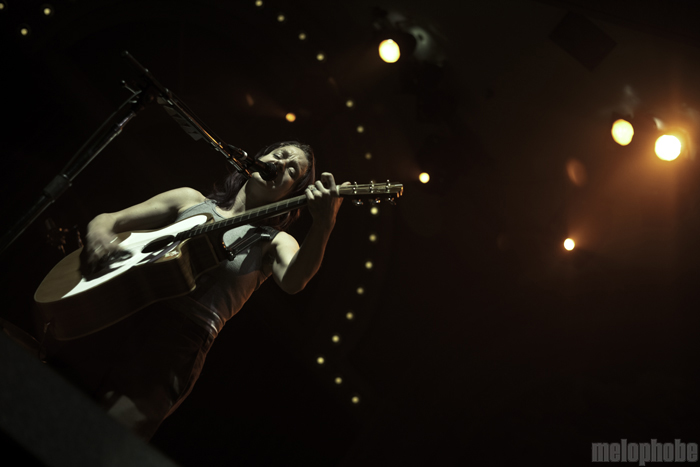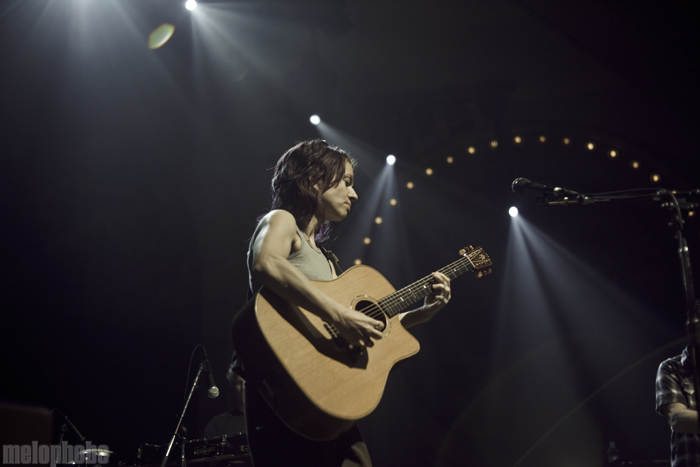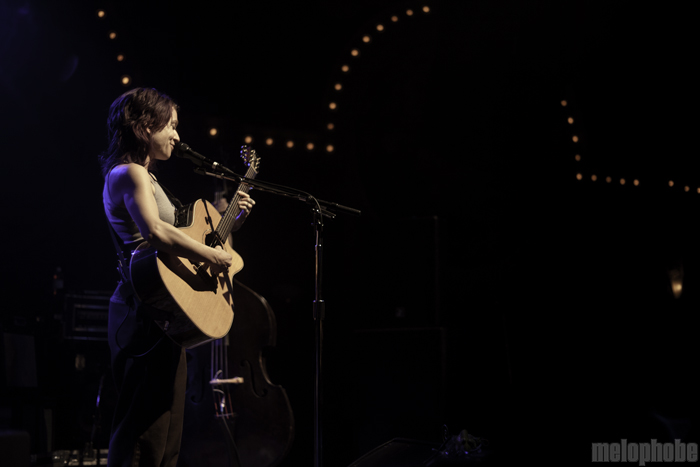
Entering the Crystal Ballroom, I am greeted by a young woman standing in front of a whiteboard. The board lists four Ani DiFranco albums, and passersby are asked to select a favorite. I waver between Little Plastic Castle and Not a Pretty Girl, and ultimately choose the latter before moving on to claim my space near the stage. It should come as no surprise that the audience is predominantly female, and many women have brought their young daughters along for a lesson in empowerment. People are oddly polite, and apologize for bumping me as they squeeze by. Though I’ve somewhat outgrown her, Ani DiFranco will always represent a particular period of my late teenage years. For an irascible young woman just discovering politics, she provided the perfect soundtrack. I’ll admit I’m apprehensive this evening. In the decade since we last shared a room, Ms. DiFranco (or Ani, as she is known by her loyal fans) has had a child and reportedly found religion – both actions uncharacteristic of the Ani I thought I knew. However, an Ani show is a space free from judgment, and I am curious to see what this night will bring.
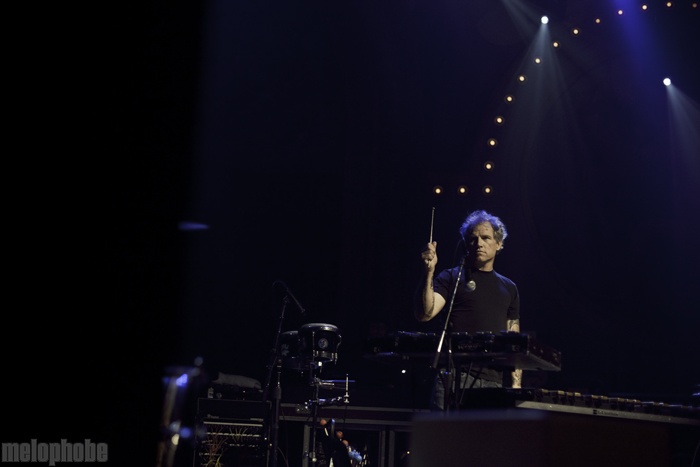
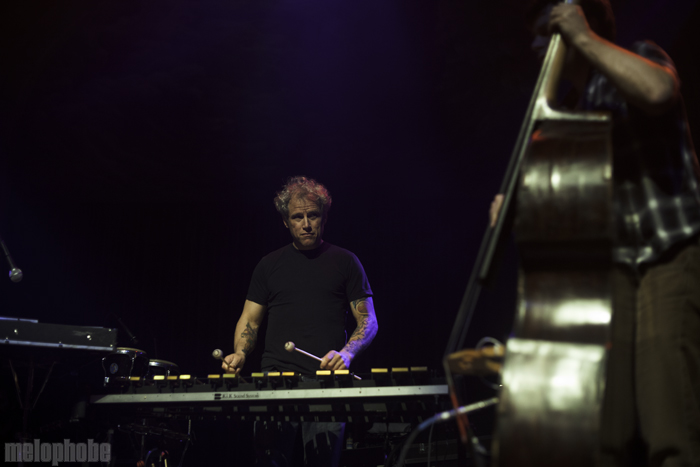
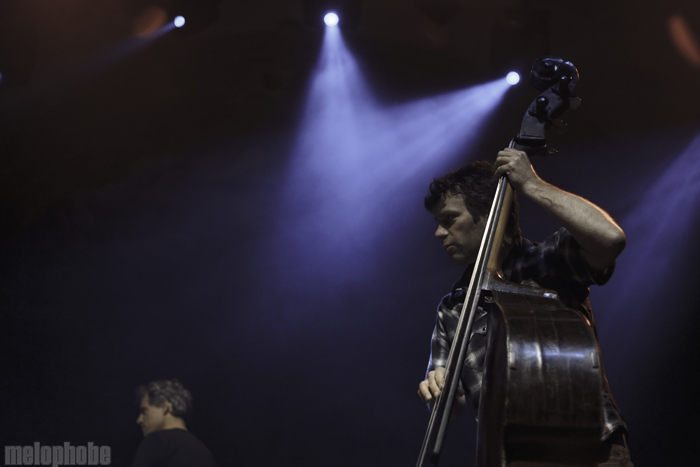
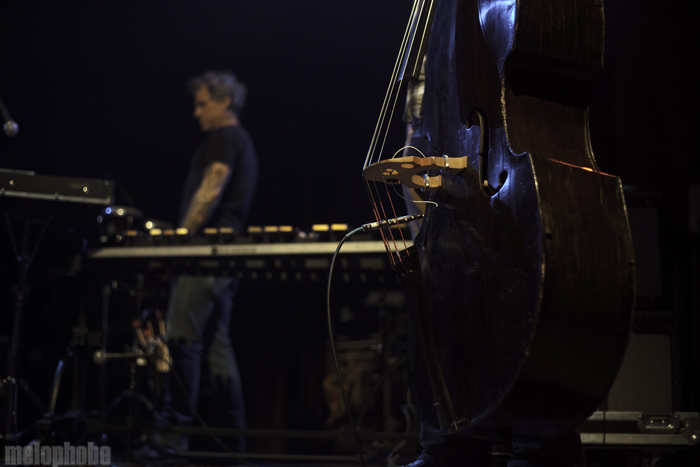
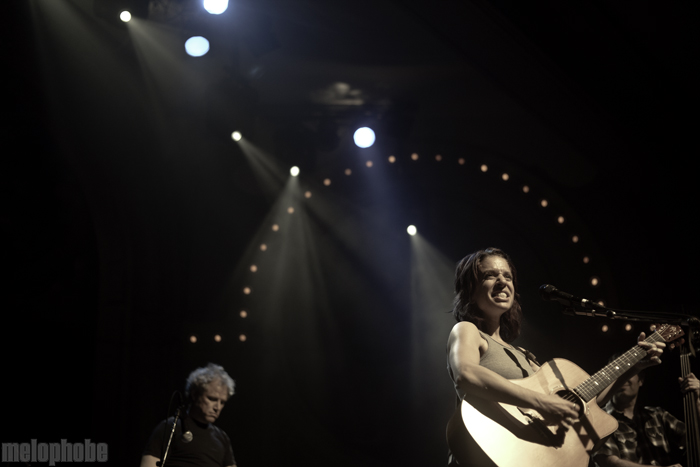
Ani and her bandmates dive immediately into "Done Wrong" upon their arrival, and the song is sufficiently spirited and raucous enough to reignite my long-dormant love of her music. She has a claw of guitar picks attached to her right hand to ease the intricate strumming patterns that are her signature. Next, "As-Is" erupts into a major sing-along, and is followed by a new song that is well-received by the willing crowd. Her band members are much livelier than she is, but there’s a graceful element to Ani’s stage presence. She performs “Fuel” in a tone that deviates wildly from its album incarnation, with a slower tempo and reggae-influenced vocals that I can’t say I enjoy. It soon becomes clear that Little Plastic Castle has won the contest, and several more of its tracks are performed over the course of the evening.
The woman of the hour pauses to tell us she doesn’t play the next song at home or in public very often. Once it starts, I understand why. When I last saw her perform, in July of 2001, the world was a different place and "Independence Day" was but a benign ditty played to celebrate the month’s major holiday. I sympathize with her reluctance to play it in the modern political climate, but she delivers a reverent and respectful rendition of it nonetheless. The next two songs are unremarkable, bordering on dull, but she recovers my interest with an exquisite musical love letter to her adopted home of New Orleans. Aside from the cheers of agreement that follow her more political missives, this crowd is unnaturally reserved. Audience members stand still, joining in on the songs they know, and listening intently to the ones they don’t.
Another new one emerges, and Ani warns us that it’s a doozy. Entitled "Amendment," it begins with a verse about the need for an amendment granting civil rights to women, and is met with boisterous approval. Its lyrics are seething and powerful. "If you don’t like abortion/ don’t have an abortion/ and teach your children/ how they can avoid them." Sing it, girl. This is the Ani I love – Ani the inspirer, Ani the truth-bearer, Ani the speaker of what we cannot say. She grits her teeth through it, but completes it flawlessly.
Shifting gears from anthems and lessons in basic feminism to more personal affairs, Ani begins a guitar refrain with which I am intimately familiar. Plucked from my list of beloved tracks I hoped to hear live, "Untouchable Face" and its strained tale of longing rings through the room. This song is a knife in my heart, and transports me to a different time. Years ago, I would crank it as loud as I could, and sing along with Ani until my voice was raw. "I could make you happy, you know/ if you weren’t already." These words are stored deep in my memory, and I quickly join the din that grows so loud it threatens to drown out the performers. Once it’s over, she concludes the set with "Which Side Are You On," an uplifting interpretation of a 1930s labor tune. One lone reveler jumps up and down, lost in a personal hoedown at the center of the crowd. Ani teaches us the chorus, and we gleefully provide backup at her request. She introduces her band, and the four of them exit the stage.
Deafening crowd noise calls her back to us, and Ani returns to perform "Every State Line," accompanied by sparse sounds from a bongo drum and a shaker. Arms outstretched in a flying motion, she begins "Gravel," and the room fills with joy. For her final song, the ever-popular "32 Flavors," she invites us to hum the melody as she sings. Once it is complete, Ani thanks us for coming and saunters off stage. At less than two hours, her performance has been much too short for someone who has been performing for 21 years and released nearly as many albums. No matter. She’ll be back next spring.
Ani's opener, Animal Prufrock, is a rapper who, when asked about gender, self-describes as "both, and…" A former member of a duo known as Bitch and Animal, Prufrock begins with a cover of that band’s best-known song, “Eternally Hard.” A smattering of audience members know the words to this one, and those who are unfamiliar laugh loudly at its comical rhymes about sex toys. The next song is unfortunately not as amusing. Influenced by Depeche Mode but without their talent or complexity, its delivery provides damning evidence that Prufrock is a far better rapper than singer. Two consecutive numbers are sung in Italian, but Prufrock explains that one is about having a vegan girlfriend and the other is about flirting with women in Italy. Prufrock's backing tracks come from an iPod, which is not queued well and thus continues playing when the songs conclude. Though these songs are fun and silly when they hit their mark, Prufrock spends much of the performance singing toward the floor instead of into the microphone. When the mic is involved, the voice it captures is untrained and amateurish. Once the performance ends, the audience is glad to see Animal Prufrock go.